Reality as They Made It
“We are as gods and have to get good at it.” These are the words that began the Whole Earth Catalog in 1967, and they are the words reprinted by literary agent John Brockman in 2009.1 Many years on, Brockman guards Whole Earth’s legacy. He represented the magazine after 1979 and became the literary agent for Brand’s book-length writing in the decades that followed. Stewart Brand has lauded Brockman as an “intellectual enzyme” who enabled otherwise impossible things.2 If the Whole Earth Catalog remains aglow in the public eye, it is because Brockman played a central role in stoking its flame. “Stewart has evolved into a legendary figure,” Brockman wrote in 1996, “who is, year in and year out, the most interesting and influential thinker I know.”3
Put up against Brand’s flamboyance, Brockman comes off demure. “My aspiration has always been to be the guy at the back of the theater that turns the lights on and turns them off,” Brockman joked at a 2019 lecture for Brand’s nonprofit The Long Now.4 In this, he has succeeded. While Brockman has long played matchmaker for intellectuals ranging from Nobel Laureates to famous artists, he rarely steps out of the shadows.
When he does, it is to publicize the intellectual networks he curates. In 1987, he took a rare interview in the summer issue of the Whole Earth Review to speak on one such success: The Reality Club. Founded in 1981, Brockman’s Reality Club sought to assemble a group for “lively and often impolite discussion.”5 He was immensely successful. Some of his first attendees included second-wave feminist Betty Friedan, inventor of the polio vaccine Jonas Salk, cybernetic mystic Heinz von Foerster, and Zen physicist Fritjof Capra.6 Over its existence, the accolades of the Reality Club attendees defy comprehension, including Nobels and Pulitzers, MacArthur Fellows and Turing Awardees. The group was invite-only, guided by Brockman’s hand on the light switch. When the club was founded, Stewart Brand was one of the first figures chosen to attend.
The history of Whole Earth is often told as a tale of Stewart Brand’s romps in the Bay Area, but what does it look like from John Brockman’s view in the Big Apple? The Reality Club highlights an alternate legacy of Whole Earth, one that seems far from the communalist counterculture of California yet cannot be separated from it. Brockman provided an intellectual platform for the members of the Whole Earth community before their fame. “Very few of our speakers are bestselling authors or famous in mass culture,” Brockman bragged. “It’s my feeling that once someone achieves such status, often he or she is no longer worth listening to.”7
The mission of the Whole Earth affiliates in New York City was nothing less than the dream of changing the world. Brockman and Brand formed a friendship over their joint excitement for the scientific developments of the 1950s and 1960s. Working amid the heady countercultural days, the friends merged mystical consciousness with high-modernist science. Both men believed that reality could be changed, that the world could become a better place, and that we just needed to find the right forces to guide it. They differed on how to get there. While Brand’s Whole Earth Catalog sought influence with the masses, Brockman courted the elite. “I believe that a tiny minority of people in the world do the significant thinking for everyone else,” Brockman brazenly admitted.8
This begs the question: Who is the “we” in Brand’s declaration “we are gods”? Brockman’s much publicized fall from grace in 2019 due to his ties with sex-offender Jeffrey Epstein challenges the easily spoken “we” of 1970s communalism. Brand and Brockman have long dreamed of changing the world—in many ways, they certainly have. Yet, the Reality Club shines light on a darker legacy of the Whole Earth dream. Forty years on, Brockman’s intellectual curation has tied together renowned scientists, beloved authors, powerful politicians, and business magnates behind the closed doors of Manhattan penthouses and Los Angeles resorts. He has pursued intellectual matchmaking with the dogged perseverance of a true believer in elite-led change.
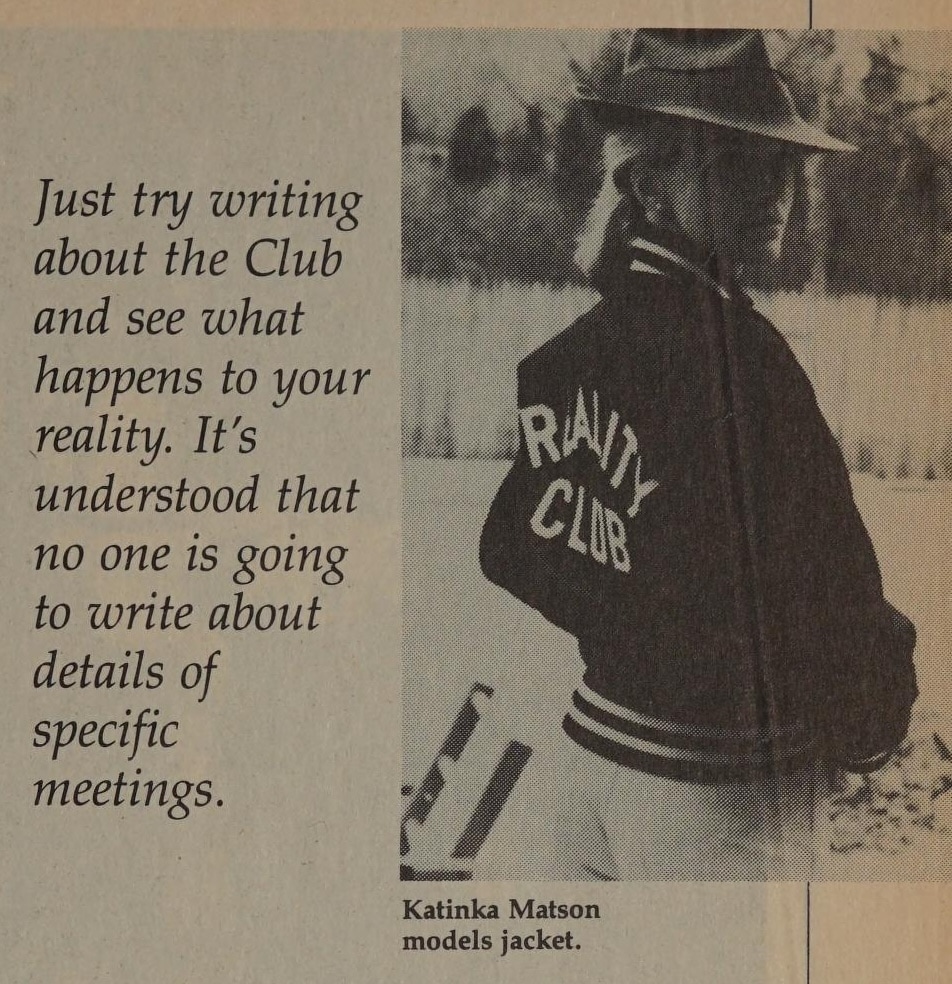
It is this theory of change that I want to focus on as a legacy of Whole Earth, a vision that reality can be created, but only by a select few. Despite its immense impact on American intellectual life, the Reality Club has remained in the shadows. This is how Brockman likes it. “Just try writing about the [Reality] Club and see what happens to your reality,” he threatened in 1987. Forty years on, let’s see.
Modernism in Manhattan and Menlo Park
Welcome to 1960s New York, a city devoured. Expressways stretched over former neighborhoods, the drone of bulldozers pealed like bells and, from the streets, citizens cried out in revolt. The Bronx had been razed in the fifties and lower Manhattan seemed to be next. City planners, equipped with the energy and authority only the engines of industry could provide, invoked their meticulously planned future to dominate the present. TNT and jackhammers promised a clean slate over a cauterized wound. Screaming amid the smog of the gasoline engine, artists and activists, community leaders and everyday citizens, took to the streets outside their lower Manhattan homes, chanting a different dream for the future. After the initial plan for the downtown expressway was struck down in 1962, the thrum of the internal combustion engine sputtered, the voices in the streets swelled and, in this cacophony, Stewart Brand met John Brockman.
The two men arrived in New York clean-cut and searching for change. Brand, disillusioned with his military service, had quit the path to become an Army Ranger and found his way to the New York bohemé through the San Francisco painter Steve Durkee.9 Brockman, also discharged from the army, enrolled at Columbia to pursue an MBA. After a quick transition to the suit-clad life of a financial consultant, Brockman oscillated between his day job on Park Avenue and evenings in the East Village, where he volunteered to organize Theatre Genesis in St. Mark’s Church-in-the-Bowery. Brockman’s management skills, or perhaps just the allure of his Ivy League MBA, caught the eye of filmmaker Jonas Mekas, who asked Brockman to organize the “New Cinema Festival.” Among a wide cast of artists, two shows were put on by the new arts collective USCO, made up of poet Gerd Stern, electrical engineer Michael Callahan, and Brand’s friend, Steve Durkee.10
Drawn together by USCO, Brand and Brockman became friends amid the breathy excitement of an arts scene finding its pulpit. Art in the 1960s was not only a fight for New York City but a fight for democracy at large. “I am for an art that is political-erotical-mystical,” wrote the sculptor Claes Oldenburg in 1961, “that does something other than sit on its ass in a museum. I am for an art that embroils itself with the everyday crap and comes out on top.”11 When the USCO art collective put on one of their earliest performances, in 1963, the everyday crap held center stage. Gerd Stern had been invited to do a poetry reading, but instead he, Durkee and Callahan had set up a multimedia performance called Verbal American Landscape. Varying pictures of street signs flashed across the wall, performers received telephone calls that were broadcast simultaneously in an echoing din, and closed-circuit televisions played the audience back to themselves as they watched the racket. The artists wanted to wake the audience up, show them their alienation in modern society. As Stern’s wife Judith Wilson recalled, “Most of our work was involved in two things: Changing consciousness… and changing the world.”12
Despite their wide-ranging experimentation, the artists were a tight-knit social crowd. Many of these breakouts, including Gerd Stern, had studied at the experimental Black Mountain College, a tiny unaccredited college ten miles outside of Asheville, North Carolina. They coalesced around John Cage, an avant-garde composer who spent many summer terms at the school.13 Cage’s public events, which attempted to blend art and life through participatory public performances, ran in parallel with his private dinners, hosted in the intimate confines of a friend’s or a colleague’s home. One day, Brockman received an invitation to these soirées.
Brockman joined the small crowd who shuffled into what would become a series of dinners held in the townhouse of multimedia poet Dick Higgins. All were young and starstruck by Cage, who served mushroom dinners and peppered them with questions about consciousness. Cage’s artistic speculation repeatedly pulled from Norbert Wiener’s scientific text Cybernetics, a book that Cage had been introduced to by physicist Natasha Goldowski while at Black Mountain.14 Cybernetics provided Cage with a framework to examine systems holistically and to think about consciousness as distributed outside the human body. “We can’t change our minds without changing the world,” Cage told the assembled crowd. One night, Cage reached into his bag after a conversation with Brockman and handed him a copy of the book. “This is for you,” he said.15
Two years later, for two days straight, Stewart Brand and John Brockman sat in Menlo Park and pondered this question. Trading cramped Manhattan streets for California air, they thumbed through Brockman’s gifted copy of Cybernetics, underlining nearly every page. Brand, recently inspired by a transcendent psychedelic experience on a moonlit rooftop, was preparing the first Whole Earth Catalog while Brockman, recently smitten with Katinka Matson, the daughter of a major literary agent in New York, was thinking of founding his own literary agency.16 Just a few months before the dawn of Whole Earth as magazine and as movement, the two friends dreamed of change. They saw a world disenchanted by immense industrial forces and scientific mechanism. “Man is dead. It’s a world of information,” Brockman would decry one year later. “What remains is the ghostly dreamworld of man—a world, an abstraction, in which participation is no longer possible.”17
Brand, on the other hand, held out hope. The shout from the street of the New York counterculture echoes in the first pages of his Whole Earth Catalog. “We are as gods… Remotely done power and glory—as via government, big business, formal education, church—has succeeded to the point where gross defects obscure actual gains,” the first page read, “In response to this dilemma and to these gains a realm of intimate personal power is developing.”18 We often think of the counterculture as escaping our modern hubris but, clearly, we should not. “We are as gods,” rang the opening words of Stewart Brand’s new catalog. Gods free to roam the earth and shape it to our will. Yet, we had mismanaged it, he claimed. We had been subject to the controls and inefficiencies of powers that claimed to be greater than ourselves. The Whole Earth Catalog printed a dream: by assembling the tools and information to assess the system in its entirety, we might recognize and act as gods once again.
When we look to California, we know this story well. The acid-dripped drum circles and neon flowers color our vision of the seventies. But what does this vision for the future look like in New York? While Brand made a racket, scampering about Silicon Valley to sell his utopian dreams, Brockman worked behind the scenes. In 1973, he founded an agency, John Brockman Associates, and became the official literary representative for Brand’s Whole Earth Catalog in 1979. His agency sold the Catalog as a product and a promise, influencing a generation of aspiring New York changemakers. Yet, Brockman diverged from Brand’s utopianism. “Man is dead,” he wrote in 1969, “but the humanist, the modern man instructed by the terms of liberal thought and conventions, will be completely unable to understand this.”19 From that point on, Brockman searched for what would come after humanism. Inviting the leading figures in science and art to his home, Brockman attempted to break out of “liberal thought” to open new paths to the future. Such an effort was dubbed The Reality Club.
Getting Real with John Brockman
Fourteen years after Brand and Brockman first met, New York had changed. Fiscal catastrophe in the 1970s brought the city to the brink of bankruptcy and, in the 1980s, mayor Edward Koch instituted widespread fiscal austerity and business deregulation in an effort to get the city back on its feet. Funding for social services was cut while Wall Street salaries exploded. It was the “go-go eighties,” as novelist Tom Wolfe dubbed it, and Brockman was at the center of this moneymaking frenzy.
Over the 1970s, Brockman profited off the books of the biggest names in American counterculture. Mysticism, it turned out, was a moneymaker. From nonconformist darlings like Fritjof Copra and his breakout bestseller, Tao of Physics, to heterodox scientists like Lynn Margulis, John Lilly, and Heinz Pagels, Brockman represented them all.20 John Brockman Associates, and its eponymous founder, were no longer shacking up with the bohemians of the Lower East Side. He was a household name in the New York literati.
Brockman responded to acceptance with disgust. “The traditional intellectuals… in America are, in a sense, reactionary and often profoundly (and perversely) ignorant of the truly significant intellectual accomplishments of our time,” he wrote.21 Citing C.P. Snow’s famous argument about the gap between the “two cultures,” the humanities and the sciences, Brockman chastised the New York literary scene for their ignorance of scientific advances. The Whole Earth Catalog was the alternative, an example of the unity that could be achieved if literary and scientific information were allowed to intermingle. Playing on Snow’s distinction, Brockman defined a new synthesis, the “Third Culture,” a union of science and art. Brockman posed a question that begged its answer: “Should we listen to the emerging voices of the third culture or to the dominant clique of tired and tiresome literary critics and their enclave of sycophants in the New York media and publishing worlds?”22
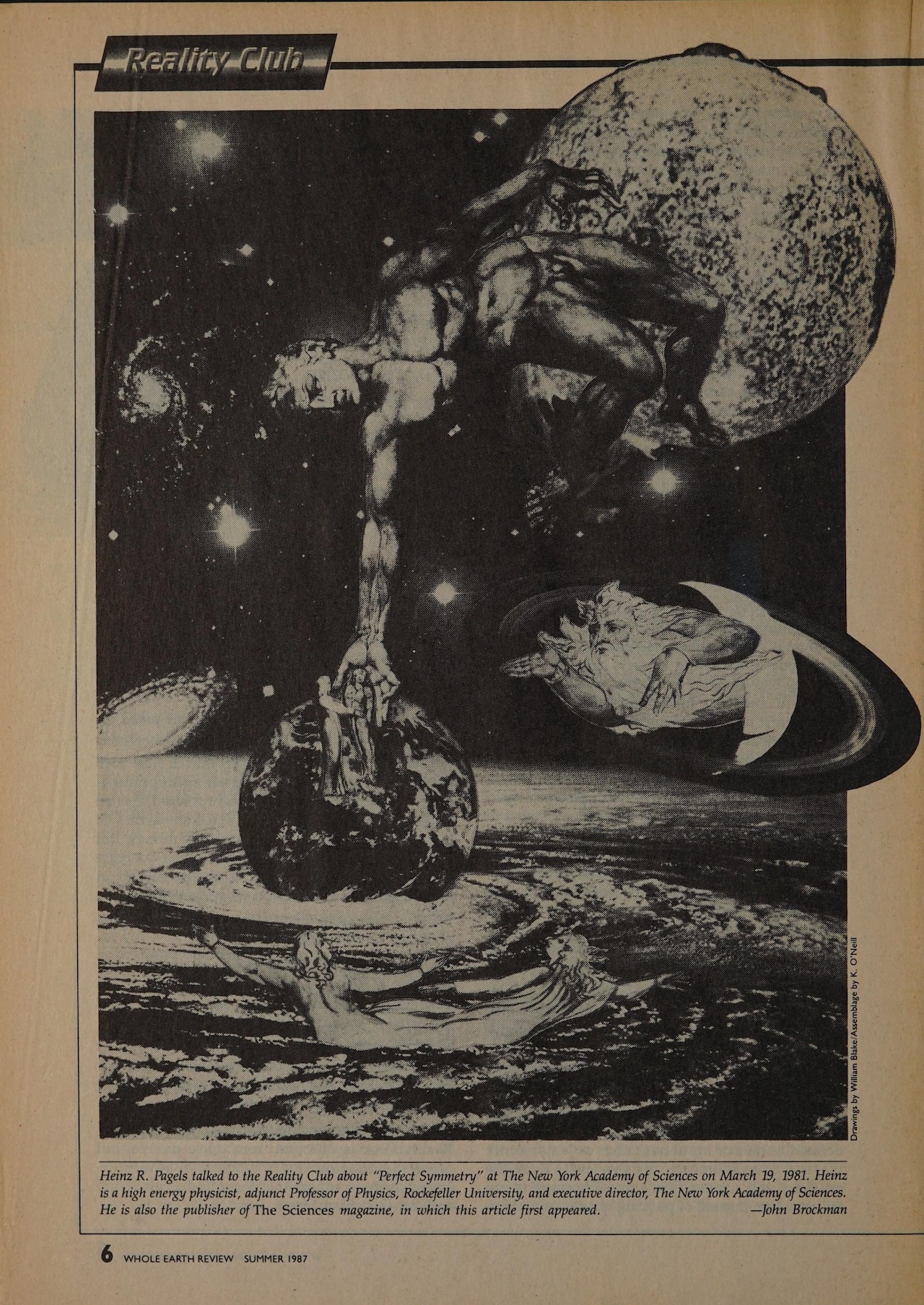
Disgruntled with American intellectual life, Brockman turned inward. Throughout the 1970s, he invited artists and scientists to his home for an informal lecture and a group discussion. From his early work in the arts, Brockman invited USCO members and writers from the ’60s counterculture. Breakout books put him in touch with scientists like cyberneticist Heinz von Foerster and geneticist Jonas Salk. As Brockman’s star power grew, he managed to attract names like Isaac Asimov and second-wave feminist Betty Friedan.23 In 1981, Brockman and physicist Heinz Pagels, the inspiration for Ian Malcom in Jurassic Park, made their informal group official. The Reality Club, as it was called, was formed as a challenge to the sycophants. “To arrive at the edge of the world’s knowledge,” the tagline for the club began, “seek out the most complex and sophisticated minds, put them in a room together, and have them ask each other the questions they are asking themselves.”24
One of the first invitations went out to Brockman’s friend, Stewart Brand. “Stewart, please RSVP,” Brockman wrote, “Hope you can come back to NYC soon!”25 The bond was not only social—the Whole Earth Catalog was an intellectual motivation for Brockman’s Third Culture. Both men shared a belief that the task of the intellectual was to change the world. In an interview published in the summer 1987 issue of the Whole Earth Review, Brockman explained, “Reality is a process of decreation. It’s what people say it is. The world, the world that we know, is not necessarily out there, it’s invention—human invention—an invention created by a finite number of people throughout history.”26 Brockman wanted to assemble those people—pluck them out of the masses trawling the streets of New York and place them in his apartment. These select few had a uniform, too. After the first year of meetings, Brockman designed matching bombers emblazoned with an in-group nickname and “REALITY CLUB” spelled in big, bold font.27
Brand and Brockman burned like twin stars. They came of age in the same intellectual ferment, a heady culture of political art in 1960s New York, and they both sought to change the world. When Brockman spoke of mass culture, one could almost feel the swirling vision of familiar psychedelic critics. “We live in a mass-produced culture,” Brockman ranted. “The way this culture is going, most Americans are the mental equivalent of shopping malls.”28 Break out! Fight back! Think more! The familiar hymn of the counterculture seemed to be finding its voice in New York City. Listen, however, for the undertone. “Is the Reality Club elitist?” asked Steven Levy, a club member. Brockman’s reply was clear. “I believe that a tiny minority of people in the world do the significant thinking for everyone else,” he told Levy. “We are elitist if that is construed as a group of people who create their own reality.”29
No friends, no spouses, no asking to be invited! These were the rules of the Reality Club. In this sense, Brockman chastised Whole Earth for doing one thing wrong—it had been too inclusive. “Franchising? That is a very Whole Earth kind of question,” mused Brockman upon being asked if others could form their own Reality Clubs. “The idea of having a Reality Club in every little town is not feasible. The Reality Club is not for everybody… The number of people who desire to explore the epistemological rhythmics of the human mind is very small.”30 Whatever “epistemological rhythmics” were, they were not for the faint of heart and certainly not for the average interlocutor. Brockman wanted to change the world but believed only a few could do it.
Over the years, its attendees numbered cultural elites across science and art. For all of Brockman’s claims to meritocracy, the club disproportionately pulled from the academic centers of an American intelligentsia. “The point is not that America is a wasteland,” Brockman opined. “Quite the contrary. Our thinkers are our greatest resource, and ideas are becoming our most important export commodity.”31
This totalizing vision was a product of its time. Brockman came of age amid a turbulent modernism, a fight for the fate of New York City born of a moment when the arts and the sciences came together for political change. For Stewart Brand, this became the basis for his communalist confidence. The Whole Earth Catalog became an information network, bridging scientists, artists, experts and the lay public, lashing them together under a metaphysics of social unity. Brockman searched for a similar unity, but in a different class. “Science is the only news,” Brockman argued, quoting his friend Stewart Brand. “The achievements of the third culture are not the marginal exploits of a quarrelsome mandarin class; they will affect the lives of everybody on the planet.”32
Whose Reality?
Whole Earth is dead. In fact, it has been dead for a while. The last Whole Earth Review came into print in 2002 and The Point Foundation, Stewart Brand’s company that published the magazine, shuttered the following year. The Reality Club, on the other hand, survived. In 1996, Brockman transitioned in person meetings to an online forum, Edge.org. His new website imported The Reality Club membership as the inaugural users of an exclusive network. Mediated via the internet rather than invitations on Brockman’s letterhead, the most recent post on Edge occurred in 2023.
Brockman continued to use the Reality Club as a model to spark conversation. Beginning in the 2000s, Brockman’s conferences were an exclusive in-group for the hottest names and the wealthiest donors in American intellectual life. During a 2008 conversation on economics, Jeff Bezos and Elon Musk arrived ready to hobnob with Nobel laureate Daniel Kahneman and future prize-winner Richard Thaler. The following year, Brockman hosted a 2009 meeting on genetics in Los Angeles and brought some of the richest CEOs in the world to converse with Salk Institute biologists, complete with a side trip to Elon Musk’s fledgling SpaceX offices. In the 2010s, the fervor only picked up. The 2019 Possible Minds conference brought together Nobel Laureates, art critics, historians, and world-renowned novelists. Stewart Brand maintained regular attendance at these meetings.33
If Whole Earth is gone, what legacy are we left with? The sprawling ecosystem of Brand’s publications imagined how the future might be changed. They are invigorating, exhilarating magazines to read. One feels the seduction of possibility, a hope that the future which seems inevitable can be changed. Yet, riding atop the energy of what could be, we must not forget what is. Whole Earth promised an array of futures, but we got this one.
In 2019, Brockman’s cultural network exploded. Investigations into his close financial and social ties to wealthy pedophile Jeffrey Epstein repelled old friends and professional colleagues.34 For a moment, Brockman was thrown into the spotlight and his role as matchmaker laid bare. Connections between art and science suddenly seemed unimportant when compared to his role in connecting America’s intellectual elites to a criminal. Quickly, Brockman retreated into the shadows once again. While John Brockman Associates still represents many authors, its namesake has stepped back from public life.
Epstein is important, but he is the end of a story, not the beginning. “We are as gods” certainly chills the reader when the “we” includes a sex offender, but it should also scare you when it is made up of billionaires like Jeff Bezos and Elon Musk, when the “we” only occurs behind closed doors that require millions of dollars or a special invitation to enter. Brockman has sold a vision of intellectual life, not just in his book contracts, but also in the boardrooms and backrooms of American high culture. Epstein bought his way in because Brockman’s intellectual mission, to unify science and art, had already become a product. The allure of the Third Culture was sold in the penthouses and sprawling mansions of New York and Los Angeles. For wealthy philanthropists with their own dreams of changing the world, inclusion into Brockman’s storied group provided intellectual legitimacy. Only a “select few” could change the world, and Brockman was the one giving tickets at the door.
The power of this movement is nothing less and nothing more than a seductive dream of the sixties—that we might use massive scientific and technological advancements to remake the world anew. Brand and Brockman became intellectuals in the heyday of this dream. Brockman spoke of science with the breathy excitement of a kid in a candy shop. Rattling off his intellectual influences, Brockman listed,
“molecular biology, artificial intelligence, chaos, massive parallelism, neural nets, the inflationary universe, fractals, complex adaptive systems, superstrings, biodiversity, nanotechnology, the human genome, expert systems, punctuated equilibrium, cellular automata, artificial life, fuzzy logic.”
Forget Socrates, here comes science. “What we are witnessing is the passing of the intellectual torch,” Brockman concluded.35
Brockman’s vision for the Third Culture was not the disenchanted science of suburban laboratories and professionalized research. He wanted a return to exploration, a romantic search for the foundations of the universe. “The ‘third culture’ is here,” Brockman exclaimed in 1992, “rendering visible the deeper meanings of our lives, redefining who and what we are in terms of our own species, the planet, the biosphere, and the cosmos.”36 Listen for the call of the counterculture in that refrain! This was to be a search for natural knowledge as a way to understand ourselves. Perhaps even a way to look at the disenchanted world and find a spark of meaning. Such a vision was not only about the excitement of discovery; it was also a call for synthesis.
The modernist confidence in technological progress and the new-age quest for meaning came together in Brockman’s dream. Science could serve both, he argued. Yet, this call is not new, and it has frightened onlookers before. In 1917, steeped in the chemical and technological horrors of the first World War, sociologist Max Weber warned against melding empirical science with the search for meaning. “It is not the gift of grace of seers and prophets dispensing sacred values,” Weber wrote. “Nor does it partake of the contemplation of sages and philosophers about the meaning of the universe.”37 Seeing the destruction science had enabled, Weber feared what would come of the dream of making science the foundation of everything.
At the turn of the twenty-first century, this totalizing dream rears its head once again. “What traditionally has been called ‘science’ has today become ‘public culture,’” Brockman wrote. “Human nature doesn't change much; science does.”38 The third culture promised synthesis but proceeded by conquest. Science was no longer the work in a laboratory or the results of a research paper—it was the source of significance for life itself. The philosopher Simone Weil dubbed this dream of totality a distinctly modern one. “Modern life is given over to immoderation,” she wrote. “Immoderation invades everything: actions and thought, public and private life.”39 Perhaps the legacy of Whole Earth points us to the immoderation of unity. An immoderation that searches for the whole picture, the final picture, with the hope that it will solve everything, merge science and art, fix the problems plaguing the world, reenchant nature, and give meaning to our existence—in other words, the promise of the ultimate social panacea.
Standing at the gates of Brockman’s utopia, one should be wary. This unity would find meaning in the world by encircling the vast diversity of our culture and placing it into the realm of science. This is a world made manipulable by homogenizing it. Is this the ascent of scientific reason or, as the composer Brian Eno asked in his final post on Edge: “Have we left the Age of Reason, never to return?”40
All is not well. Climate catastrophe and social inequities loom in our precarious present. Faced with the challenges of contemporary life, a panacea feels more seductive than ever. We must give up this dream, Brockman’s dream, of complete synthesis. We do not need to choose between the immoderate unity of the Reality Club and the lonely atomization of twenty-first century society. Unity can be achieved through a pluralism that rejects homogenization, a pluralism that seeks diversity and difference because it does not begin from the desire to control and transform. The future is still open, but one thing is certain. While the Reality Club is one legacy of Whole Earth, it need not be the last word.

- John Brockman, “A Talk with Stewart Brand,” Edge.org, August 18, 2009, accessed on April 25, 2025. https://www.edge.org/conversation/stewart_brand-we-are-as-gods-and-have-to-get-good-at-it [↩]
- John Naughton, “John Brockman: The Man Who Runs the World’s Smartest Website,” January 7, 2012, The Guardian. Accessed on April 25, 2025. https://www.theguardian.com/technology/2012/jan/08/john-brockman-edge-interview-john-naughton [↩]
- Brockman, Digerati: Encounters with the Cyber Elite (San Francisco: HardWired, 1996): 19. [↩]
- Brockman, “Possible Minds,” February 25, 2019, The Long Now Foundation, accessed on April 25, 2025. https://longnow.org/seminars/02019/feb/25/possible-minds/ [↩]
- Quoted in in Steven Levy, “The Reality Club,” Whole Earth Review 55 (1987): 2. [↩]
- Brockman, Letter to Stewart Brand, January 12, 1981. M1237.9.2, Stewart Brand Papers, Stanford University Special Collections, Stanford, CA. [↩]
- Quoted in Levy, “The Reality Club,” Whole Earth Review 55 (1987): 4. [↩]
- Quoted in Levy, “The Reality Club,” Whole Earth Review 55 (1987): 4. [↩]
- Fred Turner, From Counterculture to Cyberculture: Stewart Brand, The Whole Earth Network, and the Rise of Digital Utopianism (Chicago: University of Chicago Press, 2006): 46. [↩]
- Brockman, “Online Digital Archive,” Edge.org, accessed April 21, 2025. https://www.edge.org/jb/online.digital.archive.html [↩]
- Quoted in Barbara Rose, Claes Oldenburg (New York: MOMA, 1970), 46. [↩]
- Quoted in Turner, The Democratic Surround: Multimedia and American Liberalism from World War II to the Psychedelic Sixties (Chicago: University of Chicago Press, 2013): 252. [↩]
- Mary Emma Harris, The Arts at Black Mountain College (Cambridge, MA: MIT Press, 1987). [↩]
- Martin Duberman, Black Mountain (New York: Anchor Books, 1973): 396. [↩]
- Quoted in Brockman, “Online Digital Archive,” Edge.org, accessed April 21, 2025. [↩]
- Brockman, “Online Digital Archive,” Edge.org, accessed April 21, 2025. [↩]
- Brockman, By the Late John Brockman (New York: Macmillan, 1969), 15, 68. [↩]
- Stewart Brand, “Purpose,” Whole Earth Catalog, Fall 1968: i. [↩]
- Brockman, By the Late John Brockman, 245. [↩]
- John Brockman Associates, Client List, 1989. SC1053.160.20, Stephen H. Schneider Papers, Stanford University Special Collections, Stanford, CA. [↩]
- Brockman, “The Emerging Third Culture,” Edge: The Newsletter of the Edge Foundation, 1991, 8. SC1053.160.20, Stephen H. Schneider Papers. [↩]
- Brockman, “The Emerging Third Culture,” 8. [↩]
- Brockman, List of Attendees, Jan 12, 1981. M1237.9.2, Stewart Brand Papers, Stanford University Special Collections, Stanford, CA. [↩]
- Gerd Stern, Letter to Members of the Reality Club, Feb 4, 1982. M1237.10.1, Stewart Brand Papers. [↩]
- Brockman, Letter to Stewart Brand. [↩]
- Quoted in Levy, “The Reality Club,” 2. [↩]
- Gerd Stern, Reality Club Membership Information, 1982. M1237.10.1, Stewart Brand Papers. [↩]
- Quoted in Levy, “The Reality Club,” 4. [↩]
- Ibid. [↩]
- Ibid. [↩]
- Brockman, “The Emerging Third Culture,”, 8. [↩]
- Brockman, “The Emerging Third Culture,” 8-9. [↩]
- Brockman, “Online Digital Archive.” [↩]
- Evgeny Morozov, “Jeffrey Epstein’s Intellectual Enabler,” The New Republic, August 22, 2019. Accessed April 24, 2025. https://newrepublic.com/article/154826/jeffrey-epsteins-intellectual-enabler. [↩]
- Brockman, “The Emerging Third Culture,” 8. [↩]
- Brockman, “The Emerging Third Culture,” 4. [↩]
- Max Weber, “Science as a Vocation,” in Science and the Quest for Reality, ed. A. I. Tauber (Oxford University Press, 1946): 390. [↩]
- John Brockman, “The Emerging Third Culture,” 8. [↩]
- Simone Weil, Gravity and Grace (London: Routledge, 2003 [1952]), 153. [↩]
- Brian Eno, “2018: What is the Last Question?” Edge, accessed April 26, 2025. https://www.edge.org/response-detail/27424 [↩]
Sebastian Fernandez-Mulligan is a historian of twentieth-century science. His writing has appeared in Physics Today, Historical Studies in the Natural Sciences, and elsewhere. He currently lives in New Haven, Connecticut, where he is completing a PhD in History at Yale University.