The Whole Thing Catalog
Gordon Ashby’s Visionary Eco-Consciousness
Badly in need of a break from Whole Earth Catalog production responsibilities, Stewart Brand handed over editorship of the July 1970 supplement to a longtime collaborator, graphic designer Gordon Ashby. The result was a strange, singular departure from the standard Catalog format. Leafing through Ashby’s supplement, readers stumbled across an uncanny doppelgänger. An oddly mutated sister publication bearing the masthead Whole Thing Catalog lurked within. A distant spiral nebula supplanted the familiar cover shot of the earth’s blue marble against a black void. Emblazoned with the slogan “Finding Your Place in Space,” the Whole Thing Catalog served as an extended promotion for the consciousness-raising mission of Transformer, Ashby’s pro-bono educational venture operating out of 84 Vandewater, the street address and adopted name of his North Beach design studio.
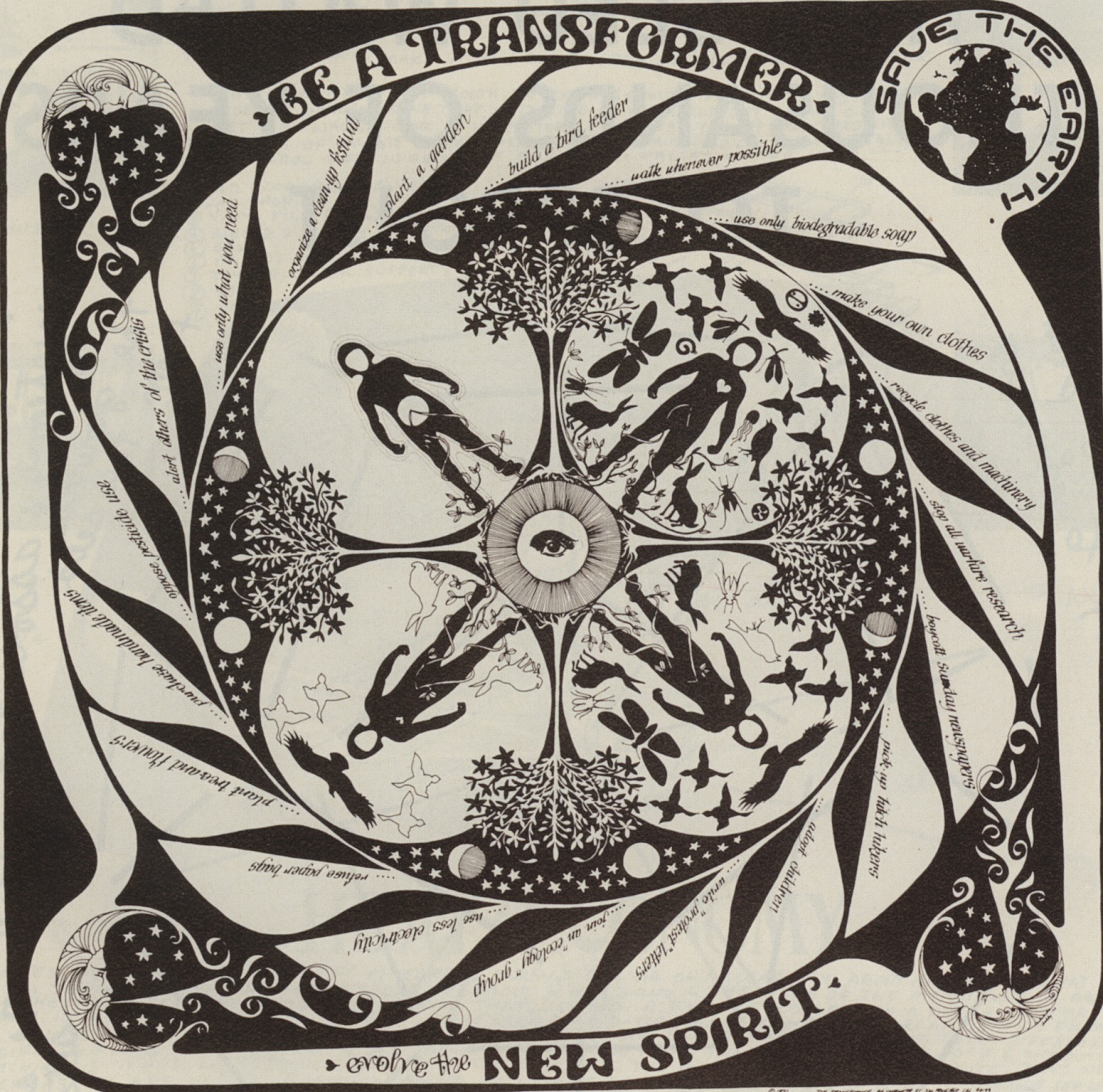
The Whole Thing Catalog was not Ashby’s only mass media pitch for the Transformer initiative. Another endorsement appeared in the July 1970 issue of Progressive Architecture, a trade publication as mainline as the Whole Earth Catalog was unconventional. Repeating his strategy of ambushing readers with the unexpected, Ashby and an accomplice, Curtis Schreier of the Ant Farm art collective, fashioned a 24-page insert titled “Advertisements for a Counter Culture.” Nested amid the usual reviews of commercial building projects sandwiched between full-page ads, their ramshackle assembly of texts, clipped snapshots, and freehand drawings, accented in lurid process colors of cyan, magenta, and yellow, flagrantly breached the journal’s slick commercial format. Each page “advertised” one of the participants at the Freestone gathering, a counterculture event held on a Sonoma County farm in March 1970 “to learn to design new social forms, new building forms, that are in harmony with life.”1 Presaging themes more fully developed in his Whole Thing Catalog, Ashby’s contribution features a mandala captioned “Be a Transformer—Evolve the New Spirit” above a clip-out, mail-in coupon for a poster version “suitable for framing” (fig. 1). Mandala quadrants are arrayed around a centering eye, the “I” of the beholder. Four encircling panels depict the biotic impoverishment of an androgynous silhouette. Read sequentially in clockwise progression, animal life vanishes, umbilical tendrils grounding the human figure wither and recede, and the figure’s shrinking heart is replaced by a clock. Read counterclockwise, reversing mechanical time, the process is inverted. Umbilical tendrils climb down to root themselves in the earth to bud and blossom; a heart replaces the clock and gradually grows larger as biodiversity flourishes. With its synthesis of ecological and mystical insights, the Transformer mandala visually encapsulates the project of cultural enlightenment that consolidated Ashby’s work as an exhibition designer, Whole Earth Catalog contributor, and itinerant teacher, and for which he would relinquish a nationally-recognized career in favor of local activism involving disruptive ecological performance art.
A capsule biography included in the Progressive Architecture insert provides insight into Ashby’s life-changing enterprise:
In order to further encourage the study of ecology from a total view, Ashby instituted the program ‘Transformer,’ with his office providing supplies, tools, facilities, skills and knowledge to persons outside the office working on ecological projects. These projects become satellites of the office and hopefully will begin to implement change. As Ashby describes it, the ‘Transformer’ changes minus energy to plus.2
The process did not work quite that way for Progressive Architecture editor Forrest Wilson, who triggered a backlash by commissioning an insert showcasing the “often unorganized, anarchistic, and irrational” style of protest favored by those who “see technology as a device able to expand man’s consciousness rather than simply a means of increasing his material well-being.”3 While intended to demonstrate his journal’s titular credentials, “Advertisements for a Counter Culture” incurred outrage among journal advertisers charged top dollar for the column inches that Wilson had provided gratis to longhairs, a magnanimous gesture that reputedly cost the journal editor his job.4
While in residence at the farmhouse that hosted the Freestone gathering, Ashby assembled his July Whole Earth Catalog supplement. The Whole Thing Catalog-within-a-catalog features seven full-page mandalas combining precise line drawings with images clipped from magazines. The resulting collages exhibit the obsessive craftsmanship and hallucinatory displacement found in the work of Ashby’s celebrated contemporary, San Francisco artist Burgess Franklin Collins, who signed his collages “Jess.” The sequence of Whole Thing mandalas provide a graphic narrative delineating the Transformer program of individual and collective metamorphosis. An opening diagram titled “The Stuff” reuses the signature Catalog image of the earth seen from space as the bullseye of an introductory mandala. The planet is encircled by a cut-and-paste shower of lifeforms—botanical, crustacean, reptilian, avian, mammalian, and human. A caption informs readers: “there are many life alternatives—but there are rules. Rules which are more like unwritten promises made between things which take into account the oneness of the scheme.” Reinforcing the mantra “everything is connected to everything else,” two ensuing diagrams advise that “knowing something about the place helps you find yours” and “knowing how the place works helps you get there.” Next, an eccentric landscape of dwellings, ranging from grass shelters and stone huts to geodesic domes and plastic inflatables, sprawls across a centerfold seam. Hovering at the horizon, a metallic sunburst radiates a collection of ethnographic portraits harvested from back issues of National Geographic. The appropriated images underscore the message that “there are many ways of doing things besides your own.” “Getting Started,” a mandala subtitled “knowing something about changing helps you live there” launches readers on their own path of transformation. The transcendent self is represented by a wire-frame figure encased in a swarm of miniature mandalas depicting objects ranging in scale from a distant galaxy to a subatomic particle. With olive branch in hand and heart made visible, the figure reminds us: “The purpose of learning is to get from where you are to where you are not.” Through these visual and textual prompts, Ashby portrays “finding your place in space” as the ultimate homecoming: an epiphany of joyful entanglement with one’s collective biotic community through the assumption of ecological guardianship as a species responsibility. The Whole Thing Catalog makes an abrupt shift in visual format at this point. Frames in a film storyboard illustrate a debate between perspectives designated “Announcer,” “Radical,” “Regular American,” and “Third World.” Their clash of competing opinions about power, wealth, natural resources, and ecological preservation, ends not with a saccharine reconciliation but the declaration that “The Earth crisis is your crisis… and mine,” and an appeal to “Change with care… compassionately.”5
The ecological ideology of the Whole Thing Catalog traces its origins to Charles and Ray Eames of the legendary Eames Office, the Los Angeles design studio where Ashby began his career. Each of the studio’s new hires received a standing invitation to develop an audiovisual treatment for Cosmic View: The Universe in Ten Jumps, a Danish children’s book by Kees Boeke. Its sequence of forty drawings nests human life in between two unimaginably vast realms, the galactic and the subatomic. “At school we are introduced to many different spheres of existence, but they are often not connected with each other,” Boeke writes, “so that we are in danger of collecting a large number of images without realizing that they all join together in one great whole.” The Eames Office produced a film version of Boeke’s whole systems narrative as Powers of Ten in 1968. Ashby chose a different medium to convey the interconnection of “spheres of existence.” Moving to San Francisco in 1963 to specialize in exhibition design and production, he employed artifacts formerly quarantined in separate natural science, state history, and fine art collections to create the Hall of California Ecology at the Oakland Museum, developed from 1964 to 1969, just as the term “ecology” was moving from scientific to public discourse. His installation narrative took the form of a visitor walk along a transect starting at the Pacific shoreline, proceeding to the Central Valley, then up into a High Sierra forest, and finally down into Death Valley. Aided by highly skilled taxidermists, artists, and technicians, Ashby recreated fragments of aspen glades and redwood groves indoors, employing museum floors as open habitat and specimen platforms punctuated with dioramas and topographic models. Praised as “revolutionary” and “less an educational experience than an educational happening,” the journey across bioregions was described by a visitor as entailing “more than vision with our eyes; it was vision we felt with our minds but saw with our eyes.”6 With its curated experience of interwoven life worlds, the exhibition augured what design theorist Simon Sadler calls the “eco-ontological” outlook of the Whole Earth Catalog, first published in 1968—four years after Ashby began planning the Hall of California Ecology.
Iconographically, the Whole Thing Catalog had less to do with Eames Office precedent, however, than with Bay Area counterculture: a “long, strange trip” that Ashby embarked upon as Stewart Brand’s mentor and confederate. Ashby co-founded the graphic design program at the San Francisco Art Institute where Brand was enrolled. Upon receiving a commission to produce an installation for New York’s Hayden Planetarium, Ashby hired Brand as a copy photographer. While shooting archival material for the project, Brand became entranced by nineteenth century almanacs and pitched the idea of producing a contemporary version to Ashby. Jim Bagnall, another associate at 84 Vanderwater, recalls the response: a deflating discussion of why Brand’s initial concept for the Whole Earth Catalog “wasn't a good idea.”7 In contrast, Ashby went all in on Brand’s plan for the January 1966 Trips Festival: a “happening” that marked his emergence as a preeminent hippie entrepreneur and which established Ashby as a mediator between San Francisco’s acid outlaws and the “inlaw” culture of corporate design. To fill three nights of programming at Longshoreman’s Hall, Brand recruited the San Francisco Tape Music Center, avant-garde filmmaker Bruce Conner, Ken Kesey and his Merry Pranksters, The Warlocks (as the Grateful Dead then were called) and an array of performance artists and light show pioneers. Among the latter, Ashby was unique in having honed his audio-visual skills at the Eames Office on commissions for high-end clients. Light Matrix, Ashby’s lightshow for the Trips Festival, began as an audio-visual prototype for a planned IBM pavilion at the 1967 Montreal World’s Fair. Designed to explain digital data systems to the uninitiated, it converted binary code into pictographs through the flickering patterns of a gridded array of lit and unlit squares turned on and off in changing configurations. When IBM decided not to participate at the Montreal Fair, Ashby used the opportunity to recycle his Light Matrix demo as psychedelic spectacle. Projected directly onto the dance floor, binary patterns and images flashed across Trips Festival celebrants, dissolving the distinction between performers and spectators to create the aesthetic and ecstatic unity that Brand intended for the event.8
The same strategy of transcendence through visual overload informed Ashby’s Transformer mandalas. Derived from the Sanskrit word for “circle,” the mandala configures symbols in concentric geometries to aid focused meditation. Popularized in the West as an archetype of wholeness through the writings of psychiatrist Carl Jung, the mandala quickly shed its Buddhist and Hindu specificities for uses that were culturally broader and at the same time more personal. In deploying the mandala to express what cultural historian Simon Sadler calls “the aesthetic organization of holism,” Ashby participated in a Bay Area legacy dating back to the Beat movement of the fifties.9 Local avant-garde filmmaker Jordan Belson credited both hallucinogens and the meditative state of Yogic Samadhi for the mutating, hypnotic geometries featured in works like Mandala (1953) and Allures (1961).10 The Esalen Institute in Big Sur, an epicenter of humanistic inquiry into psychedelic experience, offered workshops on the mandala as a “symbolic path to spiritual growth”11 Assemblage artist Bruce Conner published a series of enigmatically abstract mandalas in the San Francisco Oracle, a standard bearer for the Haight-Ashbury community. As art historian Padma Dorje Maitland notes, by the sixties “mandalas were everywhere in California: they could be found in the book shops and head shops of San Francisco and Berkeley, posters for Trips Fests and Be-Ins, [...] and later in new ecological visualizations.”12 Although hallucinogens informed Ashby’s creative process—like Brand, he had enrolled in a supervised LSD study at Menlo Park’s Foundation for Advanced Study before the drug was outlawed—his work hewed closely to the religious use of mandalas to advance higher consciousness. Ashby endorsed the symbol’s capacity to depict complex interdependencies, remarking: “Breaking away from a linear perspective, having many voices: the mandala gives that opportunity; it has many layers. An acid trip is like that.”13 The mandala was tailor-made to visualize ecological systems so interconnected that their totality exceeds the sum of individual parts. “Understanding Whole Systems means looking both larger and smaller than where our daily habits live and seeing clear through our cycles,” Brand wrote in the Whole Earth Catalog. “The result is responsibility, but the process is filled with the constant delight of surprise.”14 Ashby's eco-mandalas glorified a very specific source of delight: biophilic awe and its jubilant sense of existential embeddedness. The holistic lyricism of his July 1970 Catalog supplement prompted Diedrich Diederichsen and Anselm Franke to display pages of the Whole Thing Catalog in their 2013 exhibit, The Whole Earth: California and the Disappearance of the Outside, and to reproduce Ashby’s contribution in the exhibition catalog.15 They attributed the project artwork to Brand, however: a curatorial error that also reflected Ashby’s own disappearance from the national stage as he relinquished a high-profile media career to pursue locally-based ecological activism.
Ashby’s July 1970 Catalog supplement marked a moment of growing disenchantment with the downsides of running 84 Vandewater. In the mid-’60s, his studio had buzzed with a work-as-play ethos adopted from the Eames Office. Ashby maintained an open-door policy in the literal sense, inviting passersby to enter and comment on sketch projects pinned on fiberboard panels lining the workspace. He made the office a hip salon for San Francisco’s creative class, a place where corporate clients and elected officials mixed with local musicians, artists, and architects at high-octane candlelit lunches that might end with a giddy session of collective mural drawing on a roll of photographic backdrop paper. But by the decade’s end, the downward spiral of druggy dark energy that wreaked havoc on the counterculture community was also taking its toll at 84 Vandewater. Nighttime break-ins left storefront windows smashed. Cameras and production equipment disappeared from shelves and desktops in daylight robberies, ending not only Ashby’s policy of open access but also the freewheeling exchanges central to his creative process. As the easygoing San Francisco scene that had nurtured his exuberant live/work lifestyle dissolved, Ashby responded by decamping to the arcadian West Marin community of Inverness: a move made possible by economic resources rather more substantial than those of your average hippie “back-to-the-lander.”
An ecological catastrophe in the wake of Ashby’s editorial gig with the Whole Earth Catalog galvanized his determination to pursue the calling of a Transformer. In the predawn darkness of January 18, 1971, two Standard Oil tankers rammed each other while passing beneath a foggy Golden Gate Bridge. Seconds after the inbound Arizona Standard plowed its bow forty feet into the outbound Oregon Standard, a combined cargo of nearly nine million gallons of viscous, unrefined oil began gushing into the bay. News of the catastrophe electrified West Marin communities, sparking a grassroots mobilization effort to save Bolinas Lagoon, a pristine 1,500-acre estuary separated from the Pacific by a narrow inlet and pulsing with botanical, aquatic, and avian life. When townspeople arrived at the oil-soaked ocean shoreline in the hundreds to help, Standard Oil officials and law enforcement officers ordered them to stand down or face arrest. Undeterred, locals brought donated bales of hay to sop up gooey waterborne sludge. In an unprecedented act of solidarity, farmers joined forces with recently arrived hipsters to install an improvised set of floating log booms trailing wire mesh curtains to trap oil-soaked straw. In the days that followed, toxic sludge fouled 150 miles of pristine Northern California shoreline. Ashby and his family joined neighbors to collect oil-drenched waterfowl for shipment to an emergency cleansing station in what one reporter called “the Dunkirk of ecology.”16 Although the grassroots mobilization succeeded in saving the Bolinas Lagoon, now a national marine sanctuary, only a handful of the laundered birds survived their traumatic exposure to petrochemical pollutants.17 As a witness to this spectacle of ecological destruction, Ashby recalibrated his “place in space” to focus on local community activism and teaching. A caption inscribed within one of his Whole Thing Catalog mandalas foreshadows this shift in priorities. His handwritten text above an appropriated image of da Vinci’s Vitruvian Man reads: “Every man has inherited a part of the earth. The care he brings to the management of his piece can affect the whole.” Rather than “dropping out” as an escapist indulgence, Ashby’s back-to-the-land move nurtured a deeper engagement with ecological custodianship to defend against what he called the “deus-ex-machinas” of a corporatized economy.18
In the early 1970s, Ashby focused the Transformer project on participatory workshops that brought bioregional expertise and bioethical beliefs to students in Marin County and beyond. Jim Bagnall, a former associate at 84 Vandewater with a tenure-track position at California State Polytechnic College in San Luis Obispo, provided the opportunity to offer students in the College of Architecture and Environmental Design a Transformer seminar. It culminated with a “Finding Our Place in Space and Making a Book in 120 Hours” challenge resulting in a collaborative volume that documented students’ research journeys across a ten-mile radius from campus. Traversing paths from Morro Bay to the San Luis and Santa Lucia ranges, participants investigated flora and fauna, physical and cultural geographies, aquifers and surface water systems, and the enduring traces of landscapes past and present. In keeping with the Whole Thing Catalog dictum that “knowing something about the place helps you find yours,” students discovered their position within a terrain of varied microclimates and interdependent species, and a human landscape of changing settlement patterns, agrarian methods, and modes of resource extraction. Crucially, beyond its fact-based knowledge, the Transformer workshop cultivated an intensely emotive and embodied identification with one’s “place in space.”19
After moving his design studio from San Francisco’s North Beach to a remodeled car repair shop nestled between Tomales Bay and the Point Reyes National Seashore, Ashby published a final pitch for the Transformer project in the Winter 1975 issue of the CoEvolution Quarterly. “Finding Our Place In Space” (subtitled “a handy step by step guide for getting from where we are to where we ought to be”) consists of eight drawings, each inscribed within the circular frame of a mandala. The opening image invokes the star-spattered pattern of a distant nebula. Upon closer inspection, what appears to be a cloud of stars resolves into a swarm of stick figures, human and animal, interspersed with totemic symbols. By combining the view from a telescope with the iconography of ancient rock pictographs, Ashby compresses space and time in a single image. Succeeding pages depict seven stages of human transformation that conjoin the spiritual with the earthly; unlike the “Way of Sorrows” depicted in the fourteen Stations of the Cross, Ashby’s devotional sequence telegraphs not the pain but rather the joy of bodily resurrection. Step One, captioned “clear your head / clean up your dreams / get easy and believe in the new possibilities,” depicts a winged angel hovering with arms outstretched, his transparent body networked with veins and nerves. He makes landfall in the next panel, which counsels: “move about / look down / pick a place / come down gently and tune yourself to the natural vibrations.” Steps Three and Four show him shedding wings that suddenly have become superfluous. Roots sprouting from his feet dive into the ground: “look and listen / move slow / tread softly / stay open and be part of what the place is being,” Ashby instructs, “grow slowly / flow steady / try hard / don’t worry / remember that everything is connected.” In panels Five and Six, his terrestrial anchorage sprouts an umbilical bough. It pushes upward and blooms; birds gather about a crowning blossom. Ashby’s captions become commandments: “live lightly on the land / share / recycle / do less with less / dream small / feel big / care / teach children / think healthy / this is the glue that holds things together.” A closing image returns to a familiar mandala centered on the planet. Four fallen angels, each holding aloft a flowering umbilical shoot, mark the diagram’s cardinal points. Ashby bestows a parting benediction: “maintain yourself / steward the earth / love and we will all have a place in space.” Consecrating the development of an earthbound soul reattuned to sacred whole systems precepts, Ashby argues for biophilic custodianship as an ecstatic alternative to the seductions of consumer citizenship.
The CQ depictions of a spirit made earthly owe much to the visionary imagery of William Blake. Almost two centuries earlier, Blake asserted an equally sublime concurrence of the human and the angelic and, like Ashby, conveyed it in line drawings harnessed to hand-lettered text. Blake renounced the estrangement of the soul from the material world as a diabolical delusion and celebrated the sacraments of both metaphysical and corporeal love. This deeply personal mythology made Blake a forsaken prophet during his lifetime but proved mesmerizing to Beat cultural dissidents and their counterculture successors. Shortly before Ashby’s arrival in San Francisco, overlapping artistic circles made the city an epicenter of the Blake renaissance. Blake’s “prophetic priestly consciousness,” in the words of Alan Ginsberg, is invoked in the opening stanza of his epochal poem Howl, with its “angelheaded hipsters burning for the ancient heavenly connection to the starry dynamo in the machinery of night.” Social theorist Theodore Roszak, whose bestseller The Making of a Counter Culture popularized that term, prefaced his study with a quote from Blake—“Rouse up, O Young Men of the New Age!”—and declared the book an “effort to work out the political meaning of William Blake’s prophetic poems.”20 The poet Michael McClure declared in 1968: “Blake is as present today as if he were biologically alive.”21 An echo of Blake’s declaration “now... is the return of Adam into Paradise" can be detected in Brand’s epigram “We are as gods and might as well get good at it,” the aphorism that introduces his Whole Earth Catalog as well as Ashby’s Whole Thing Catalog.22 Ashby joined Bay Area poets Ginsberg, McClure, and Robert Duncan, as well as artists Jess, Helen Adam, Wallace Berman, and Jay De Feo, in seizing “a specific aspect of Blake’s art and thought useful to their own project” and applying it to “creative experiments at the margins of American culture,” as art historian Elizabeth Ferrell observes.23 Unlike his peers, however, Ashby’s reprocessing of the Blake legacy is distinguished by a complete disengagement from its recurrent demonic and apocalyptic themes. After witnessing fume-choked shorelines animated by the slap of tarry waves and agonies of blackened waterfowl, Ashby had little use for metaphoric death trips. He chose instead to celebrate Blake’s exalted unification of body, spirit, and nature as the rapturous inheritance of an ecological millenarianism.
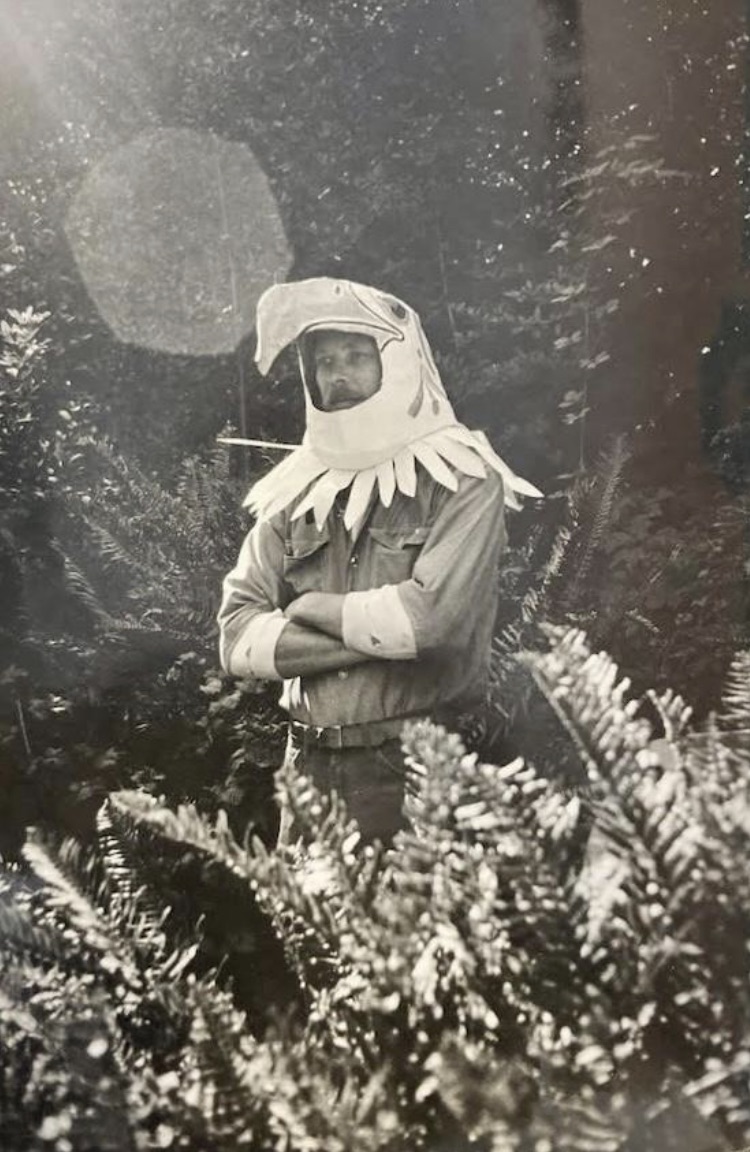
A photograph of Ashby in the Environmental Design Archives at UC Berkeley shows him standing, arms crossed, in waist-high foliage at the edge of a West Marin forest. The undated black-and-white portrait appears to have been shot in the late 1970s. Ashby’s determined expression seems at odds with his whimsical headgear, a helmet-like paper-mâché mask resting on his shoulders and capped by a raptor’s head and projecting beak: an avian disguise that resembles the Haida “transformation masks” of the Pacific Northwest used in ceremonies to represent a tribal ancestor or mark an encounter with a supernatural being. It also recalls the work of Ashby’s former employers, Charles and Ray Eames, who designed a series of playful, oversized bird and animal head masks intended for production but never marketed, and which instead found use as props for office photographs and costumes for skits. Ashby used his eagle mask for “serious fun,” as the Eames Office motto went, in performances indebted to the “life acting” practices devised by the Diggers, an anarchic San Francisco street theater collective of the mid-’60s. The 1966 Digger manifesto “Trip Without a Ticket” called for the proliferation of “Life acts! Acts that can create the condition of life that they describe!” In staged events like the “Death of Money” parade down Haight Street and “Free Frame of Reference” food giveaways in Panhandle Park, Digger life actors used public theater to prefigure realities that radical social change could make possible.
Ashby put his masked performance to similarly instrumental use at hearings of Marin County’s Planning Commission and Board of Supervisors, where he and a handful of eco-freak confederates would appear in wildlife regalia to voice the concerns of animals impacted by zoning and development decisions but unable to speak for themselves. What must have been regarded, even for Northern California, as outlandishly eccentric behavior at a public meeting resonates today with visions of “a more inclusive definition of life, and a greater moral-ethical response and responsibility to non-human life forms,” as Pramod Neyar characterizes the contemporary posthuman condition.24 Ashby’s self-elected role as nature’s representative prefigured a question directed at Denmark’s failed 2009 UN Climate Change conference by French philosopher Michel Serres: “Who wasn’t invited to Copenhagen?” Published in the newspaper Libération, his critique pondered how the living planet itself could be granted the opportunity to sit and speak and exert agency at its life-or-death deliberations.25
Serres and Ashby share two other conceptual enthusiasms: the contemporary role of the angel as harbinger and message-bearer, and the survival value of experiencing deep time.26 Both perceived the frenetically shallow tempos of consumer modernity as inimical to a lived understanding of the “rhythms and range” of ecological timescales. In 1992, Serres declared:
If there is material, technological, and industrial pollution that exposes the climate to conceivable risks, there is a second, invisible pollution that endangers time: cultural pollution, to which we have subjected the thoughts of the long term that are guardians of the Earth, of men, and of things themselves. Without fighting this second pollution we will lose the battle against the first.27
In Ashby’s graphic manifesto published two decades earlier in the CoEvolution Quarterly, he depicts the first step in the transformation from flighty apparition to grounded being as a voluntary reduction of velocity. He urges us to “move slow - tread softly - stay open and be part of what the place is being.” Across the breadth of the Transformer initiative, from mandalas asserting that “creation is the stuff of time” and “time is the stuff of the universe” to workshops sensitizing students to their place within geological and evolutionary processes, Ashby insists that an embodied habitation of the longue durée is prerequisite to “evolving the new spirit.” Time is central to the Transformer message, not in the sense of calibrated chronology, but rather through changes in the culture of temporality, that is, in the way that we subjectively experience and collectively construe our immersion in deep time.
Another visionary concerned with the problem of modernity’s constricted temporal foothold is Ashby’s colleague and former employee, Stewart Brand. “Civilization is revving itself into a pathologically short attention span,” he argues. “Some sort of balancing corrective to the short-sightedness is needed—some mechanism or myth which encourages the long view and the taking of long-term responsibility, where ‘long-term’ is measured at least in centuries.”28 To address this temporal short-sightedness, Brand has joined a project to create a monumental underground chronometer, the Clock of the Long Now, devised to remain accurate for the next 10,000 years: equal to the timespan that has elapsed since the emergence of civilization (at least in Brand’s reckoning).29 A prototype of the most expensive timepiece ever created is now under construction in West Texas on land provided by tech billionaire Jeff Bezos. “Ideally,” according to Brand, “it would do for thinking about time what the photographs of Earth from space have done for thinking about the environment.”30 Assembled from titanium, advanced ceramics, quartz, sapphire, and stainless steel, its gargantuan components will be wound by human custodians over the coming millennia, or so the builders believe.
Rather than placing faith in the power of mechanical hardware as an instrument of longue durée perception, Ashby approaches temporality through the cultural software of myth, ritual, and performance. Unlike the technology and maintenance schedule required of a 10,000 year timepiece, the subjective and emotive experience of deep time has proven its long-term viability as a framework for ecological custodianship. For the last 50,000 years, First Australians have assumed responsibility for what they call “country” through their access to Everywhen, an English-language neologism that adds poetic nuance to what Anglophones have historically called “The Dreaming.” The deep past is not inaccessible to Aboriginal Australians, as Yamatji art historian and curator Stephen Gilchrist notes. “Indigenous conceptions of time rely on active encounters with both the ancestral and natural worlds, and these dynamic relationships find expression in artistic production.”31 Like Aboriginal contemporary art, Ashby’s works in the Whole Earth Catalog and the CoEvolution Quarterly can be read as ontological diagrams. They direct us toward “Finding Our Place in Space” as well as in deep time, blurring boundaries between human and non-human lifeworlds, situating us in a present that simultaneously embodies distant pasts and futures. If “We are as gods and might as well get good at it,” Ashby would have us celebrate our obligations as stewards of a biotic community rather than as keepers of a buried chronograph.
- Forrest Wilson, “Advertisements for a Counter Culture,” Progressive Architecture 51, no. 6 (July 1970): 70. [↩]
- Wilson, “Advertisements for a Counter Culture,” 72. [↩]
- Wilson, “Advertisements for a Counter Culture,” 70. [↩]
- In interviews with the author from 2012-14, Gordon Ashby, Jim Campe, Chip Lord, and Sim Van der Ryn each attributed Wilson’s departure from his post as editor of Progressive Architecture to the negative reception of “Advertisements for a Counter Culture.” [↩]
- Gordon Ashby, “Find Your Place in Space,” Whole Earth Catalog, July 1970. [↩]
- Lori Fogarty, "Transforming the Gallery of California Natural Sciences," September 2014, 1, https://museumca.org/wp-content/uploads/2025/03/Essay_Introduction_Fogarty.pdf; T.H. Watkins, “A Walk Across California,” Cry California 4, No. 4 (Fall 1969): 11. [↩]
- Author interview with Gordon Ashby, Inverness CA, 14 November 2014; telephone conversation with Jim Bagnall, 6 May 2025. [↩]
- Gordon Ashby, interview by author, 2014. [↩]
- Simon Sadler, “Mandalas or Raised Fists? Hippie Holism, Panther Totality, and Another Modernism,” in Hippie Modernism: The Struggle for Utopia, ed. Andrew Blauvelt (Minneapolis: Walker Art Center, 2015), 122. [↩]
- Mark Harris, “Countercultural Intoxication: An Aesthetics of Transformation,” in West of Center: Art and the Counterculture Experiment in America, 1965-1977, ed. Elissa Auther and Adam Lerner (Minneapolis: Univ. of Minnesota Press, 2012), 329-30. [↩]
- José and Miriam Argüelles, “Symbolic Paths to Spiritual Growth: The Mandala,” Audiotape 12901 (Tiburon CA: Big Sur Tapes, 1970). [↩]
- Padma Dorje Maitland, “Mandalas,” Critical Sustainabilities, March 25, 2016, https://critical-sustainabilities.ucsc.edu/mandalas/ [↩]
- Author interview with Gordon Ashby, November 14, 2014. [↩]
- Steward Brand, ed., The Next Whole Earth Catalog: Access to Tools (New York: Random House, 1980), 6. [↩]
- Diedrich Diederichsen and Anselm Franke, eds., The Whole Earth: California and the Disappearance of the Outside (Berlin: Sternberg Press, 2013). [↩]
- Author interviews with Micah Van der Ryn and Gordon and Teresa Ashby, October 3, 2024. [↩]
- “Battle of Bolinas Bay Won by the Good Guys,” Oakland Tribune, January 22, 1971; Peter T. White, “Barehanded Battle to Cleanse the Bay,” National Geographic 139, no. 6 (June 1971): 873–75; both cited in Shirley Freitas, “The San Francisco Oil Spill of 1971,” Necessary Storms, July 4, 2023. https://www.necessarystorms.com/home/the-san-francisco-oil-spill-of-1971. [↩]
- I am grateful to Johanna Mehl for pointing out the shift to from national to local mobilization in Ashby's work as an ecological activist. [↩]
- Gordon Ashby, “Finding Your Place in Space,” in Finding a Place in Space and Making a Book in 120 Hours, eds. The Folks at Rainbow Corners (San Luis Obispo, CA: California State Polytechnic College, 1972), Gordon Ashby papers, Environmental Design Archives, University of California, Berkeley. [↩]
- William Blake, selections from ‘Milton’; John P. Murphy, “Building Golgonooza in the Age of Aquarius,” in William Blake and the Age of Aquarius, ed. Stephen F. Eisenman (Princeton, NJ: Princeton University Press, 2017), 164. [↩]
- Michael McClure, “Wolf Net: Part One,” 1970. [↩]
- William Blake, The Marriage of Heaven and Hell (1793), 14. [↩]
- Elizabeth Ferrell, “William Blake on the West Coast,” in Eisenman, William Blake and the Age of Aquarius, 138. [↩]
- Pramod K. Nayar, Posthumanism (Cambridge: Polity Press, 2014) [↩]
- Michel Serres, “La non-invitée au sommet de Copenhague,” Libération, December 9, 2009; cited in Bruno Latour, “An Attempt at a Compositionist Manifesto,” New Literary History 41, 2010: 478–79. [↩]
- Michel Serres, Angels: A Modern Myth (Paris: Flammarion, 1995). [↩]
- Michel Serres, “The Natural Contract,” trans. Felicia McCarren, Critical Inquiry 19, no. 1 (1992): 5. [↩]
- Stewart Brand, The Clock of the Long Now: Time and Responsibility (New York: Basic Books, 1999), 2. [↩]
- Brand, The Clock of the Long Now, 4. [↩]
- Brand, The Clock of the Long Now, 3. [↩]
- Stephen Gilchrist, Everywhen: The Eternal Present in Indigenous Art from Australia (Cambridge, MA: Harvard Art Museums, 2016), 19. [↩]
Greg Castillo is a Professor of architectural history at the University of California at Berkeley. He was the guest curator of the 2017 Hippie Modernism exhibition at the Berkeley Museum of Art and Pacific Film Archive, the author of numerous articles on Bay Area counterculture, and the co-editor of Design Radicals: Spaces of Bay Area Counterculture, forthcoming from the University of Minnesota Press.