The Metric Con
Stewart Brand, Imperial Units, and the Politics of Measurement
“The centimeter is unloveable, inhuman, and not even really convenient. It is the chill breath of vicious Fascist conspiracy.”
In 1975, as the United States made its latest (and last) half-hearted attempt at converting to the metric system, Stewart Brand launched his anti-metric campaign. The first salvo fired in this one-sided war was the “Metric System Con,” written by Steve Baer with an introduction by Brand, published in the Winter 1974 issue of the CoEvolution Quarterly. Baer, designer of the Drop City Domes, took a both-sides approach to the question of metrication. He listed its singular advantage, that it was divisible by 10, and its numerous cons: its smugness, its foreignness, and its bureaucratic meddling that spread its stamp of rationality where it had no business being. Besides, he continued, imperial’s base 12, which is easily halved and halved again, is far superior to lengthy decimal equivalents; conversion is easy; and a foot is a foot—why have a painted piece of wood to repeat what’s already at the end of your leg?1
Brand advised that the proper response to metrication was to “bitch, boycott and foment.”2 Between 1974 and 1981, bracketing the existence of the United States Metric Conversion Board, Brand published more than twenty articles, excerpts, and editorials opposing the adoption of the metric system, alongside pieces like “Indian Basket Weaving” and “Man-made planets, seriously.” He included any and all anti-metric arguments, from union reps concerned about losing jobs overseas, to the more outlandish cosmological and spiritual defenses. Not for the first time, the Whole Earth project found itself representing a coalition of cranks, conspiracy theorists, paranoiacs, contrarians, New Age spiritualists, and the everyman.
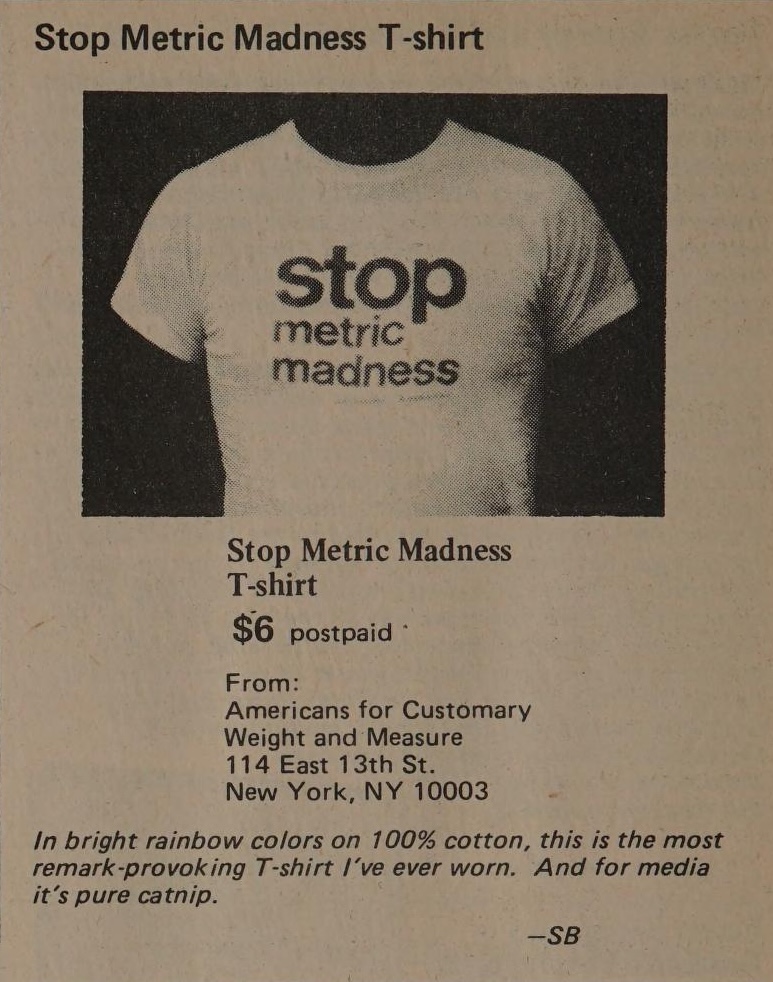
Brand’s anti-metric advocacy wasn’t confined to the pages of the CoEvolution Quarterly. While serving as a special advisor to Governor Jerry Brown of California, Brand was appointed to the California Metric Conversion council where he got to “watch the very forefront (foreback? backfront?) of the process” and lobby against it.3 In 1979, he put out a call for submissions to a metric argument book, never to be published,4 and in 1981, he helped organize the Manhattan Foot Ball, where attendees, including Tom Wolfe, protested the metric system, toasted the yard and the pound, and participated in the Most Beautiful Foot contest.5
Brand’s case against metrication wasn’t about the relative merits of feet versus meters—he acknowledged metric’s usefulness for physicists, chemists, doctors, dope fiends, and owners of foreign cars6—but about power, politics, and identity. Metrication symbolized everything the Whole Earth project stood against: top-down standardization, institutional control, social and political monoculture, and the erasure of local and embodied knowledge.
The metric system—with its air of scientific rationality, promise of universality, and whiff of Continental utopianism—appears to be an obvious tool for a project dedicated to “Whole Earth Systems Thinking.” Brand, a student of biology and prescient techno-positivist who advocated for space colonies and the personal computer, sustainability, and communitarianism, rejected a system that seemed to embody or enable so many of these same things. His anti-metric stance feels out of place among so many other techno-enthusiasms, but it’s consistent with Whole Earth’s broader project to articulate a new scalar relationship between humans and our planetary system.
The Metric System
The French Revolution brought us many innovations, notably the guillotine and—far more enduring—the metric system. At the time of the revolution, France had around two and a half thousand different named units of measurement, with more than a quarter million variations. It was a system ripe for confusion and exploitation.7 “One king, one law, one weight, and one measure” was a prominent revolutionary rallying cry and a standardized system of weights and measures was number 13 on the list of grievances in the Cahiers de doléances ahead of the revolution.
The new metric system—begun under Louis XVI, created by a group of scientists and savants, and implemented by the revolutionary government in 1795—aspired to new republican ideals of equality. It derived its authority, not from man, or king, or God, but from the laws of nature. Its units would be based on the impartial body of the Earth, not the foot of the king.8 “The meter would be eternal because the earth was eternal. And the meter would belong equally to all the people of the world, just as the earth belonged equally to them all.”9 In the words of the French mathematician and philosopher Marquis de Condorcet, the metric system was “for all people, for all time.”
On its face, this seems like the kind of rational, atheistic, whole-earth project that would be right at home on the pages of the Catalog. A Utopian striving for Rationality, systematicity, clarity, and equality, tied to the earth itself. But metric, it turns out, was just as arbitrary, compromised, and co-optable as any other top-down system, measurement or otherwise.
After years of heated debate between preeminent savants, and a few false starts,10 the meter was defined as one ten-millionth of the distance from the North Pole to the equator, measured along the meridian running through Paris. The Academy of Science sent Jean-Baptiste Delambre and Pierre Méchain, equipped with the 18th century’s most advanced scientific instruments, to measure the length of the meridian arc. For the next seven years, they scaled church steeples and the hills between Barcelona and Dunkirk, triangulating distances and making painstaking calculations. Once completed, it would be a simple matter of compiling their data, extrapolating the length, dividing it by ten million, and finally revealing the length of the meter.
But their measurements threw the whole rational, idealized project into disarray and undermined its entire premise. Their data revealed that the meridian wasn’t a smooth and elegant arc, and that the Earth wasn’t a perfect sphere, but an irregular, dented, wrinkled, and lopsided geoid. No meridian was the same length and so their calculations couldn’t yield a universal measure. The meter—conceived as for all people and for all time—was in fact, for Paris and just then. The Earth refused to conform to mathematical formulas.11 The Earth offered no absolutes.
The subsequent calculation of the meter, described by one historian as a “mathematical patch-up job,”12 smoothed the wrinkled Earth to better fit the savants’ ideal form and numbers. Modern satellite imaging has since revealed their measurement to be off by the thickness of a few sheets of paper—on one hand, astonishingly accurate and on the other, a large enough error to be visible to the naked eye and make a difference in high-precision science.
The metricators ultimately preferred the purity of their ideals over the messy reality of the Earth, and mistakes made during that process (the results of crude instruments, human error, and later human coverups) were enshrined in the system of measurement and inscribed on a platinum-iridium bar—a physical manifestation of their new rational order, which is still housed in Paris alongside other artifacts of the Revolution, like The Vindication of the Rights of Man.
Since the invention of the metric system, the length of the meter—measuring not quite one ten-millionth of the Earth’s meridian—and the weight of the kilogram have remained the same, but have been redefined using increasingly abstract principles. In 1960, the meter was redefined as the wavelength of krypton-86 radiation, and in 1983, it was redefined as the length light travels in a vacuum during 1/299,792,458 of a second.13 Each redefinition is tied to a newly discovered, immutable constant of the universe, reflecting the system’s infinite perfectibility and the lie at the heart of the system—the meter defines nothing but itself.
The metric system emerged, with the best of intentions, from Enlightenment ideals of rationality and equality. But what began as an attempt to ground human order in nature, wound up flattening the complexity of the Earth, contorting it to fit within a neatly rational and decimalized system—even as it laid claim to the impartial objectivity of nature. Its approach is antithetical to the whole-earth systems thinking of Brand and the Whole Earth project, which sought to acknowledge the Earth in all its intricacy.
The metric system was as much a political endeavor as it was scientific, and Whole Earth’s critique of its ideology was pointed. The creators and proponents of the system within France were elites who stood to gain the most from a universal system and smoother business transactions: tax collectors, merchants, landowners, and bureaucrats. The engineer, politician, and metricator Prieur de la Côte-d’Or stated its goal explicitly: the introduction of metric standards would make commerce in France “direct, healthy, and rapid,” transforming the country into “a vast market, each part exchanging its surplus.”14 The metric system, from its first implementation, was intended to create a new, rational society and—essential to any liberal political economy—a (inter)national market.15
Almost two hundred years later, Brand warned that the metricated world would be a “relentless marketplace planet with everything for sale,” where “everything is readily transferable into everything else and nothing remains truly native or isolated.”16 Brand asked whose interests were served by global standardization, and his answer was: bureaucrats, multinational corporations, and defense contractors. The efficiency and clarity promised by the metric system were ultimately about profit and control—clearly stated by its founding fathers.
Anti-Metric Sentiment: at Home and Abroad
Though the US is often depicted as the lone truculent holdout, with Myanmar and Liberia as honorable mentions, there has been anti-metric resistance for as long as there has been a meter. It was rejected almost immediately by the French commoners—the very people it aimed to elevate—and then by Napoleon, who diluted its use within France, even as he forcibly exported it across Europe. Global metrication was messy: it happened in fits and starts, almost always during times of political upheaval and alongside other attempts at unification and standardization. It was always under pressure, and almost always a top-down imposition—sometimes as a form of colonial control, other times a symbol of newfound independence, but always as a tool of industrial modernization.
Why was the United States, another nascent republic born of revolution, immune to this metric churn? In the late 18th century—as the fledgling states rejected British monarchy, currency, and even spelling—metrication looked like a promising solution for a new, non-British system of weights and measures. With Thomas Jefferson, a known Francophile and natural philosopher, at the helm, it seemed like a foregone conclusion that the U.S. would be an early and eager adopter, but it never found a foothold with the American public.
The history of anti-metric sentiment in America is complicated, with reasons ranging from anti-French sentiment to pirates and sacred pyramidal geometry, but mainly economic. During the 19th and 20th centuries, the U.S. and the U.K. were manufacturing superpowers and, unlike smaller or newly industrialized countries, the cost of retooling infrastructure to metric would be immense with no economic incentive to switch. The U.K. didn’t transition to metric until 1965, as its empire and global influence waned, and America never metricated because they never had to.
The imperial system has remained the only real and functional alternative to the metric system, and anti-metric opposition in both the United States and the United Kingdom has taken on a kind of defiant nationalism. For the British fighting Napoleon the promise of “one king, one law, one weight, and one measure” wasn’t aspirational, it was a threat. More recently, U.K. Brexiteers have linked their nationalist project to imperial units, with Boris Johnson going so far as to promise its reinstatement post-Brexit. Tony Bennett of the U.K.’s Active Resistance to Metrication (ARM), interviewed by science writer James Vincent, sees the European Union as a deliberate attempt to erase God-ordained national sovereignty through a single language, currency, and system of measure.17
In the U.S., imperial units are part of the country’s founding myth. The Land Ordinance of 1785, drafted by Thomas Jefferson, parceled the vast expanses of the western territories, sight unseen, into a grid of 6-square-mile townships, 640-acre parcels, and 160-acre lots. The 40-acre parcel sits at the heart of the nation’s origin story, as central and symbolically charged as the seven days of creation in the Book of Genesis. During the Cold War, the threat to America was no longer just French, but communist, too: “Metric is definitely communist,” said Dean Krakel, director of the National Cowboy Hall of Fame in Oklahoma. “One monetary system, one language, one weight and measurement system, one world—all communist.” Bob Greene, founder of the WAM! (We Ain’t Metric) organization, agreed: it was all an Arab plot “with some Frenchies and Limeys thrown in.”18
It would surprise most Americans, then, to learn that the United States officially adopted metric standards in 1893 and U.S. customary units like the foot and the pound are defined via the metric system.19 The United States has been secretly metric for over one hundred years and its messy hybrid system reflects the nation's fractured modernity and ambivalence towards globalization. Its money, military, medication, and automotive industry—pillars of American culture—are all metric, and while soda comes in liters most items on the grocery store shelves are labeled in both customary and metric. If the U.S. ever fully adopts the metric system, it will signal its own decline—the last gasp of exceptionalism—and its need to play well with others at last.
Brand’s defense of the imperial system toes the line between nationalism and localism, but his rhetoric was never jingoistic or exclusionary. Imperial units function as a standardized, top-down system, just like metric, so his stance was largely symbolic. Customary units aren’t just familiar and practical tools, they’re embedded in the language, tools, literature, and daily rhythms of American life. To abandon them would erase a functional, lived system in favor of an abstract ideal. His resistance to global standardization was not about isolationism, but about preserving the richness of local specificity.
For Brand, the friction of translation—between language, between currencies, between cultures, values, and yes, units of measurement—was productive and healthy. Metrication sought to smooth out the complexities of national culture in favor of global uniformity and market convenience, a change that would benefit corporations, not citizens. Resisting standardization and institutional control, emblematized by metrication, was a way of ensuring abundant diversity, whereas universal liquidity, enabled by metric, was a barren sea.20
Measurements Shape Reality
“When you can measure what you are speaking about, and express it in numbers, you know something about it, when you cannot express it in numbers, your knowledge is of a meager and unsatisfactory kind; it may be the beginning of knowledge, but you have scarcely, in your thoughts, advanced to the stage of science.”
The anti-metric arguments of Brand and others tell us something important: systems of measurement aren’t neutral or objective. They are how we understand and ultimately control the world around us. They shape, and are shaped by, the cultures that use them. Since the first Neanderthal notched a bone or ancient Babylonian astrologers mapped the heavens, measurement systems have been inscribed with meaning. What we choose to measure and the tools we measure with—from land survey grids to eugenicist skull calipers—don’t just represent reality, they create it.
Or, as Baer put it in that anti-metric first essay, “as systems of measure extend they cease to be simply measures. They become, instead, recommendations for the size of things.”21 Thermometers, scales, rulers, and clocks don’t just record information; they transform our experience of the world. A scale mediates our sense of weight: instead of something feeling heavy or light, it becomes a number, embedded in a system (kilograms or pounds) shaped by social and cultural ideas of health or strength. A thermometer turns a sensation, “it’s hot,” into a number (98°F or 36.7°C) that becomes part of an evaluative framework.22 The ancient Greeks had four degrees of temperatures: very cold, cold, warm, and hot.23 Today, if we feel hot or cold, the thermometer tells us just how hot or how cold. We interpret the world through these technological interfaces that have “displaced human experience as the arbiter of reality.”24
The inhumanity of the metric system was a recurring theme in the CoEvolution Quarterly. Published in the Winter 1978 issue, “Human Fahrenheit, Inhuman Celsius” by Brian Toss compares the 0 to 100 scale of Celsius and Fahrenheit. Celsius was based on the freezing and boiling point of water, while Fahrenheit brackets the habitable extremes of the European climate. Fahrenheit then, “is a high-definition system of great humanness,” Toss writes, “immediately understandable and easily used since it relates specifically to humans, and not just the characteristics of water. Unlike the Celsius scale it is a reflection and extension of ourselves; it does not have the effect of squeezing us into a sterile, high-tech worldview, residents of a 15 to 40 niche, a fraction of scale having little to do with our daily lives.”25
Access to (Ancient + High-Tech) Tools
For most of human history, systems of measurement were tied to the human body and the particulars of human experiences. A foot was the size of a foot, a stone was something you could hold, and in many languages, the word for inch is still the same as the word for thumb.26 The historian Robert Crease said that a useful unit of measurement must be accessible, more or less consistent, and appropriate for the task.27 Units derived from the body are always on hand and always the right size for the job, a definition that echoes one reader’s understanding of a Whole Earth tool: “I always thought tools were objects, things: screw drivers, wrenches, axes, hoes. Now I realize that tools are a process: using the right-sized and shaped object in the most effective way to get a job done.”28
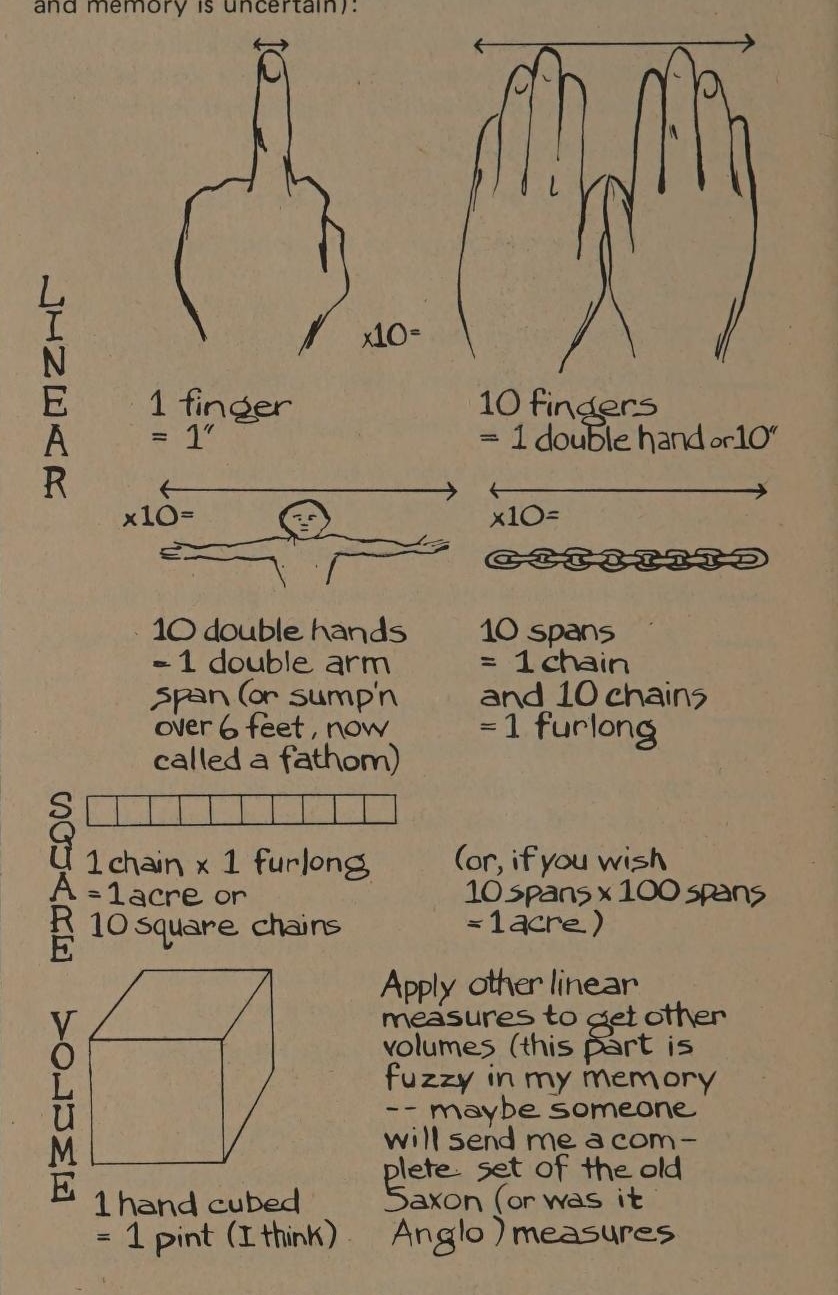
Ancient units, like the yard, the bushel, the furlong, and the acre, emerged through use, not fiat, and contained embodied information that transcended quantification. The original definition of an acre was the amount of land that could be plowed in a day by a team of oxen. The old Irish unit, the collop, was the amount of land needed to support one family or graze a single cow. A collop of lush, nutrient-rich pasture would be smaller than a collop of less productive soil—the unit expands and contracts based on the quality of the land. These units do more than measure area; they embed information about the terrain and the reality of labor that abstract units flatten or erase entirely.29
The imperial system is a hodgepodge of Anglo-Saxon, Roman, and medieval systems, with roots going back over 6,000 years to ancient Mesopotamia. Centuries of formalization and attempts at standardization have only added to its strange accumulation of histories, languages, units, and derivations.30 The inch, first defined as the width of a man’s thumb, was redefined in the Magna Carta as three barleycorns laid end to end; a yard is the distance from the tip of the nose to the end of King Henry I’s outstretched arm; the mile originated from the Roman mille passus, meaning a thousand paces. The abbreviation “lb” for pound comes from the Latin libra, which means balance, as in scales. Ounce comes from the Latin unica, meaning one-twelfth because the Roman pound was divided into twelve units (not sixteen like ours), and ton derives from tun, a large cask for wine.31
The things that needed measuring could be touched, grasped by human hands, or borrowed from the immediate environment—they were tangible. Work and trade existed at a scale legible to the human body and so the units were deeply localized, tied to specific places and labor practices. Embodied systems like these were illegible to outsiders and resistant to centralized authority and control—which today could be seen as a feature, not a bug. Their variability and specificity complicated attempts at uniformity across regions, professions, and markets.32 Standardization was an essential instrument of international trade, state oversight, and later industrialization and scientific inquiry.
As human communities grew and trade networks extended across continents, as we began to peer outward through telescopes and inwards through microscopes, customary units were no longer sufficient. The world had expanded beyond the scale of the body. What was once intuitive now appeared as imprecise and unverifiable. The shift from customary to standardized units mirrored a broader cultural shift—from embodied to abstract forms of knowledge, and from local to global—the very states and scales Whole Earth toggled between.
The combination of ancient and new technologies, as outlined in Fred Turner’s seminal work From Counterculture to Cyberculture, was essential for this expansive Whole Earth project. The imperial system, as defended in the pages of the Catalog, should be understood as an ancient technology or a form of indigenous knowledge—not indigenous to the land or its original inhabitants, but to the colonial-settler-cowboy-pioneer the back-to-the-land movement venerated and emulated. “The Metric System Con” by Baer was included in the Soft Technology section of CQ, and later included in the 1978 publication Soft-Tech, in recognition of its tool-ness.33 In the article “Soft Tech Defined,” Brand listed thirty-five characteristics that defined Soft Technology, including: ecologically sound, craft industry, village emphasis, decentralist, integration with nature, democratic politics, local bartering, compatible with local culture, operating goals understandable by all, and technical goals valid—a self-conscious echo of the French metrication rallying cry “for all men for all time.”34
The imperial system, idealized as it was by Brand and his cohort as embodied, intuitive, and human-scaled, was a soft technology. It represented an essential tool for downscaling, democratizing, and humanizing an increasingly sterile and rational high-tech society.35 While the metric system promised universal legibility, Brand feared it came at the expense of subjective, local, and embodied experience. He believed in the liberatory potential of technology and at the same time, like Hannah Arendt, “feared that its distance and abstraction could replace human subjectivity and closeness in a world previously experienced communally, alongside fellow human beings.”36
But the CoEvolution Quarterly’s argument for the American customary system wasn’t reactionary or nostalgic, and Brand was no Luddite. The Whole Earth project believed the right technology could foster a more interconnected and sustainable world and understood the capacity of technology to shape human experience—and beyond that, to reshape human subjectivity.
To Brand, the worst, most destructive forms of technology were top-down impositions: inhuman, abstract forces—the atom bomb and the metric system—that aided the smooth transactions of capital. The best technologies—the imperial system, the Catalog itself, and later the internet—were emergent, peer-to-peer, bottom-up, embodied, and based on human connections. This view allowed the Whole Earth network to be both evangelists for global connectivity and vociferous opponents of globalization. Brand’s techno-optimism was rooted in the belief that individuals, not institutions, should shape their tools. He platformed tools and technologies that could scale intimacy, not impose abstraction.
Digital Space and Unit Collapse
In 1978, Brand declared victory with the headline: “America Is Not Switching to Metric.” “Metric conversion is already complete in America,” he said. “The people who can use its virtues are using it, and the rest will continue to ignore it.”37 In 1982, only five years after the passing of the Metric Conversion Act, President Reagan disbanded the United States Metric Board and scuttled its floundering efforts.
The last Brand has to say on the subject—at least in the pages of CQ—is in the Summer 1981 issue, in a book review of Metric Madness by J.W. Batchelder, sandwiched between a survival guide and “Biological damage standards”:
“I honor metric—S.I. anyways—for its uses in science, and for that reason I favor continued dual teaching of metric and customary measure in schools. Otherwise I am glad to see conversion going the way of Esperanto and New Math. Whatever the worthiness of the idea, it didn’t work at all. There’s no shame in that. Most good ideas don’t.”38
But the triumph of imperial over metric in America did not dam up the barren sea of global liquidity Brand warned of. It was the cyberculture Brand championed that finished the job of globalization and made the world a flat marketplace. The Whole Earth project understood early that technology could ease—and even erase—the burden of unit conversion, and of translation more broadly.39 In 1974, a few calculator clicks made metric and imperial interchangeable.40
Today, physical units are all but irrelevant. Metric, imperial, Modulor, pixels, and points all coexist in the digital realm. Within digital space, measurement systems are fluid: the global units of CAD programs and digital design suites can be changed in the settings or overridden at will—type “cm” or “in” and the system translates automatically. A designer can think in inches, draw in centimeters, and export in pixels. Responsive design ensures that apps and websites adapt seamlessly across units and devices. It is a universal space of infinite planes, infinitely scalable vectors, and endless scrolls. Everything is interoperable. In virtual space, no size is absolute—all relationships are scalar. Distance is collapsed. Weight is immaterial. The only truly relevant measurement is informational: the bit, the byte, the nibble.
The Ideology of Frictionlessness
Systems of measurement are tools for understanding and controlling the world around us. They are cultural artifacts, extensions of the societies that created them and encoded with meaning. What political views and systems of control are embedded in our new measurement systems, and what does it mean to measure anything at all in an age of virtual space?
Customary units, derived from the human body, symbolize embodied and localized knowledge. The metric system, rooted in the laws of nature, represented Enlightenment ideals of universalism and rationalism. Today’s digital units promise frictionlessness.
In digital space, translation is automatic, experiences seamless, and results instantaneous. Friction—what Brand believed to be a source of richness, texture, and resistance—is nearly non-existent. As Brand feared, everything has become transferable into everything else—everything is data.
Historically, tools of measurement like scales and thermometers, extended and augmented human’s sensory capabilities. They allowed us to record temperature more precisely and weigh with greater accuracy, extending our knowledge of and dominion over the natural world. While they sharpened our perceptive abilities and made us more exquisitely attuned to the world around us, they were still tools that we could hold, designed for and anchored by the human body. But today’s digital tools do more than extend our senses: they transcend them entirely.
These new informational units derive their authority not from the human body or the body of the earth, but from increasingly complex computational models, machine learning systems, and algorithms that exceed human ability, human comprehension, and, perhaps, even human control. They exceed our grasp. The system’s claim to objectivity is no longer embodied or planetary, but algorithmic. In this new regime, the human body is increasingly irrelevant. It is either disembodied or reduced to a series of data points, reimagined as a system of inputs and outputs that can be as rigorously optimized and smoothly functional as the system itself. This digital system says: there is nothing that can’t be measured, nothing that can’t be known, and nothing that can’t be controlled—just not by humans.
Echoing Buckminster Fuller’s famous provocation—“How much does your building weigh, Mr. Architect?”—scientists now ask: How much does the internet weigh? Not the physical infrastructure of the internet—its massive server farms or the miles (and kilometers) of fiber optic cables—but the internet itself: the sum total of human knowledge rendered in binary code. If information is energy, and energy has mass41 then the internet has weight.42 Like the French revolutionaries before them, today’s scientists have appealed to the building blocks of nature to create a system of measurement: if 1 gram of DNA can encode 215 petabytes of information, that means the internet—currently estimated at 175 zettabytes—is 960,947 grams’ worth of DNA. Or, as Wired put it, the same weight as “10.6 American males. Or one-third of a Cybertruck. Or 64,000 strawberries.”43
The number means nothing, but the effort to calculate the weight of something as intangible as information speaks to our innate desire to weigh and measure as a means of understanding—to make something knowable, graspable, and controllable. To make it material again. The source of friction now—and the potential for abundant diversity at the fringes—is the translation from digital to physical. Revit models become buildings and walls must be framed with tools that obey gravity and (for now) the limits of human reach. Graphics are printed and RGB fills are converted to CMYK ink. Clearly mapped routes shown on satellite are terrain that needs to be traversed. The digital must eventually become physical, just as every system of measurement eventually collides with the messiness of the Earth and the bodies of its inhabitants.
Stewart Brand’s anti-metric battle was never about measurement—it was about meaning. Brand understood that tools, and access to tools, do more than quantify; they encode values, shape behavior, and build worlds. His defense of the imperial system, whose units were derived from the body, the land, and the particulars of human experience, was a symbolic act of resistance against the abstracting and the totalizing forces that reduced everything to interchangeable units. It’s an argument that remains urgent, relevant, and worth revisiting. In an increasingly frictionless world, the inch and the foot remind us that, even in virtual realms, we remain tethered to the material and the world we can grasp. The inch may no longer define the world, but it still helps us hold on to it.
- Steve Baer, “Metric System Con,” CoEvolution Quarterly, Winter Solstice 1974, 67. https://wholeearth.info/p/coevolution-quarterly-winter-1974?format=spreads&index=71 [↩]
- Amir Alexander, “Not Giving an Inch,” review of Whatever Happened to the Metric System? by John Bemelmans Marciano, The New York Times, August 24, 2014. https://www.nytimes.com/2014/08/24/books/review/whatever-happened-to-the-metric-system-by-john-bemelmans-marciano.html [↩]
- New Scientist, cover image, October 30, 1980, accessed May 26, 2025, https://themetricmaven.com/wp-content/uploads/2017/10/New-Scientist-1980-10-30.png [↩]
- Stewart Brand, “Material Invited for CQ Metric Argument Book.” CoEvolution Quarterly, Summer 1979, 22. [↩]
- Paul L. Montgomery, “800 Putting Best Foot Forward Attend a Gala Against Metrics.” The New York Times, June 1, 1981. [↩]
- Stewart Brand, “America Is Not Switching to Metric.” The CoEvolution Quarterly Whole Earth Jamboree 1968-1978, Winter 1978, 16–17. [↩]
- Peasants were taxed by feudal lords who used larger bushels than those used by the peasants at market. [↩]
- James Vincent, Beyond Measure: The Hidden History of Measurement from Cubits to Quantum Constants (New York: W. W. Norton, 2022), audiobook, track 6, 6:35. [↩]
- Ken Alder, The Measure of All Things (Simon & Schuster, 2014), 1. [↩]
- They originally proposed using a second pendulum but rates vary depending on location due to gravity. [↩]
- Alder, The Measure of All Things, 263. [↩]
- D. Graham Burnett, “The Error of All Things,” American Scientist 91, no. 2 (March-April 2003): 166-168. https://www.americanscientist.org/article/the-error-of-all-things [↩]
- What we refer to as the metric system has, since 1960, meant The International System of Units (Système international d'unités) or SI, the modern form of the metric system and the world's most widely used system of measurement. [↩]
- Vincent, Beyond Measure, 169-170 [↩]
- Burnett, “The Error of All Things,” 166-168. [↩]
- Stewart Brand, introduction to “Metric System Con” by Steve Baer, CoEvolution Quarterly, Winter 1974, 66. [↩]
- James Vincent, “The battle of the standards: why the US and UK can’t stop fighting the metric system,” The Verge, January 16, 2023. [↩]
- Alexander, “Not Giving an Inch.” [↩]
- 1 yard is legally defined as 0.9144 meter and 1 avoirdupois pound as 0.45359237 kilograms. [↩]
- Brand, introduction to “Metric System Con” by Baer, 66. [↩]
- Baer, “Metric System Con,” 67. [↩]
- Don Ihde, Bodies in Technology (Minneapolis: University of Minnesota Press, 2002). [↩]
- Denny, Neil. Little Atoms. (2022, July 4). Little Atoms 756 [Audio podcast episode]. In Little Atoms. Apple Podcasts. [↩]
- Vincent, Beyond Measure, 135. [↩]
- Brian Toss, “Human Fahrenheit, Inhuman Celsius,” CoEvolution Quarterly, Winter 1978, 17. [↩]
- Examples include Catalan: polzada ("inch") and polze ("thumb"); Czech: palec ("thumb"); Danish and Norwegian: tomme ("inch") French: pouce; Georgian: დუიმი, Hungarian: hüvelyk; Italian: pollice; Portuguese: polegada ("inch") and polegar ("thumb"); ("duim"); Slovak: palec ("thumb"); Spanish: pulgada ("inch") and pulgar ("thumb"); and Swedish: tum ("inch") and tumme ("thumb"). While in Dutch, the word for inch is engelse duim (english thumb). From: Wikipedia contributors. (n.d.). Inch. Wikipedia. Retrieved May 26, 2025, from https://en.wikipedia.org/wiki/Inch#:~:text=Examples%20 include%20 Catalan%3A%20 polzada%20(%22,)%20and%20polegar%20(%22thumb%22) [↩]
- Robert P. Crease, World in the Balance: The Historic Quest for an Absolute System of Measurement (New York: W. W. Norton, 1993). [↩]
- Fred Turner, From Counterculture to Cyberculture: Stewart Brand, the Whole Earth Network, and the Rise of Digital Utopianism (Chicago: University of Chicago Press, 2006), 83. [↩]
- Vincent, Beyond Measure, 267. [↩]
- Steven A. Treese, “Metric and U.S. Customary/English Systems,” in History and Measurement of the Base and Derived Units (Cham: Springer, 2018), https://doi.org/10.1007/978-3-319-77577-7_3. [↩]
- Local Histories, A Brief History of Measurement, accessed May 26, 2025, from https://localhistories.org/a-brief-history-of-measurement/. [↩]
- James C. Scott, Seeing like a State: How Certain Schemes to Improve the Human Condition Have Failed (New Haven: Yale University Press, 1998). [↩]
- Later installments were published in the Politics section. [↩]
- Robin Clarke, “Some Utopian Characteristics of Soft Technology.” CoEvolution Quarterly, Winter Solstice 1974, 59. [↩]
- Turner, From Counterculture to Cyberculture, 70. [↩]
- Hannah Arendt quoted in Vincent, Beyond Measure, 338. [↩]
- Brand, “America Is Not Switching to Metric,” 16-17. [↩]
- Brand, “America Is Not Switching to Metric,” 16-17. [↩]
- Baer, “Metric System Con,” 67. [↩]
- Baer, “Metric System Con,” 67. [↩]
- Per Einstein’s E = mc². [↩]
- 1 zettabyte = 10247 bytes and 1 byte = 8 bits. [↩]
- Samantha Spengler, “The Weight of the Internet Will Shock You.” WIRED, March 24, 2025. https://www.wired.com/story/weight-of-the-internet/ [↩]

Annie Schneider is an American-Canadian curator, designer, and writer based in London.