Sadomasochism, Cyborgs, and Women
Finding Feminist Tools for Survival in the Whole Earth Catalog
The mission of the Whole Earth Catalog, as stated by its founder Stewart Brand, was to provide access to “tools for survival.” What exactly does that mean? Flipping through the catalog’s pages, one finds a selection of gear appropriate for homesteaders or back-to-the-land communards: leatherworking tools, homebrew supplies, wood stoves. But more often than not, the “tools” that the catalog promotes are books (or some other kind of print media), including many how-to guides for alternative living but by no means limited to DIY content. There are many books on poetry, Eastern spirituality, and generally expanding one’s consciousness; there are reviews of periodicals documenting the vibrant activism of the era. Brand was less explicit about the political commitments of the Whole Earth project itself, approaching the catalog format as a marketplace of radical ideas. While the project was guided by Brand’s vision of a life lived in accordance with ecological justice and harmony, he appeared more interested in this as a condition of individual enlightenment, rather than as a goal to collectively organize toward. This was an early source of criticism.
The New Woman’s Survival Catalog, a feminist take on the Whole Earth format, launched in 1973. In the introduction, the catalog’s editors denounce “the male hip counterculture” that they characterize as performative and empty. In contrast, they argue, The New Woman’s Survival Catalog represents “an active attempt to reshape culture through changing values and consciousness.” Brand eventually came to explain the ideological gaps between his project and the New Left as a difference of approach, arguing that the latter’s focus was “grassroots political (i.e., referred) power,” whereas “Whole Earth eschewed politics and pushed grassroots direct power—tools and skills.”1 In other words, knowledge is power—but the more pressing cause, for Brand’s feminist critics, was to critique and dismantle power itself. The idea that “the personal is political” began circulating around the same time the Whole Earth Catalog did; in 1979, poet and feminist activist Audre Lorde gave an influential speech addressing the concept, arguing that “survival is not an academic skill.” She continues: “The master's tools will never dismantle the master's house. They may allow us temporarily to beat him at his own game, but they will never enable us to bring about genuine change.”2 Though Lorde’s statement was not directed specifically at Stewart Brand or the Whole Earth Catalog, it accurately critiques the project’s innate contradictions—the idea that it could be both radical and apolitical, grassroots and libertarian.
Whole Earth’s ideological slipperiness (and the fact that it constitutes an enormous archive of material published over 34 years) makes it a difficult object to define writ large. One thing that seems clear, though, is that the form and design of the catalog—how it collected and disseminated information—was often the source of its radical potential. Despite Brand’s focus on individual empowerment, the Whole Earth Catalog evolved into a truly participatory publishing platform after it achieved a certain amount of cultural saturation in the 1970s. The attention and revenue generated by the catalog fed directly into a periodical supplement, which regularly changed title and editorial focus (the Supplement to the Whole Earth Catalog grew into the CoEvolution Quarterly, then the Whole Earth Software Review, then the Whole Earth Review) but the editorial approach remained consistently inconsistent, in that it was wildly heterogenous and open to reader participation.
In Adjusted Margin: Xerography, Art and Activism in the Late Twentieth Century, Kate Eichhorn examines how the advent of the xerox machine “promoted the emergence of new and increasingly heterogeneous types of publics,” and in many cases, “counterpublics,” a concept she attributes to the queer theorist Michael Warner. Warner explains that counterpublics are communities “defined by their tension with a larger public”:
A counterpublic, against the background of the public sphere, enables a horizon of opinion and exchange; its exchanges remain distinct from authority and can have a critical relation to power; its extent is in principle indefinite, because it is not based on a precise demography but mediated by print, theater, diffuse networks of talk, commerce, and the like.3
Eichhorn’s book highlights how activist groups such as ACT UP, the coalition that worked to end the AIDS crisis, used xeroxed posters to create a counterpublic sphere in the consumer-driven urban environment of New York City. A similar dynamic existed in the world of small press publishing and distribution. Whole Earth, not unlike ACT UP, modified the visual rhetoric of advertising and publicity to suit its own mission, but unlike ACT UP, its content was both crowd-sourced and (at least at first) filtered through a singular editorial vision (Brand). Unlike most other catalogs, Whole Earth wasn’t selling the products listed on its pages directly, nor, in most cases, was it profiting from facilitating sales. It was simply selling access to a specific, curated kind of information, something that had previously only existed as word of mouth. Brand referred to the catalog’s readers as “users,” and his role as editor was comparable to that of a moderator; perhaps sometimes a user experience designer. Brand prompted prospective contributors to write their reviews “as if writing a letter to a friend,” rather than as a subject expert (and these “reviews” are more accurately described as recommendations; he didn’t want to waste space on things that didn’t work). This friendly format gave the catalog an increasingly wide appeal, allowing it to transcend its surface function—promoting books and products—and read more like a guidebook for joining a new, exciting, enlightened way of life.
It is against this backdrop that the Whole Earth platform, though not often remembered for its commitment to women’s liberation, helped enable a feminist counterpublic. While this discourse bubbled up throughout Whole Earth’s history, three artifacts perhaps best distill the publication’s curious engagement with feminist thought across several decades. By refracting each of these examples through the prism of Whole Earth’s commitment to disseminating information about “tools for survival,” the points of convergence between feminist politics and the do-it-yourself individualism of the counterculture become clear.
Shulamith Firestone’s The Dialectic of Sex4
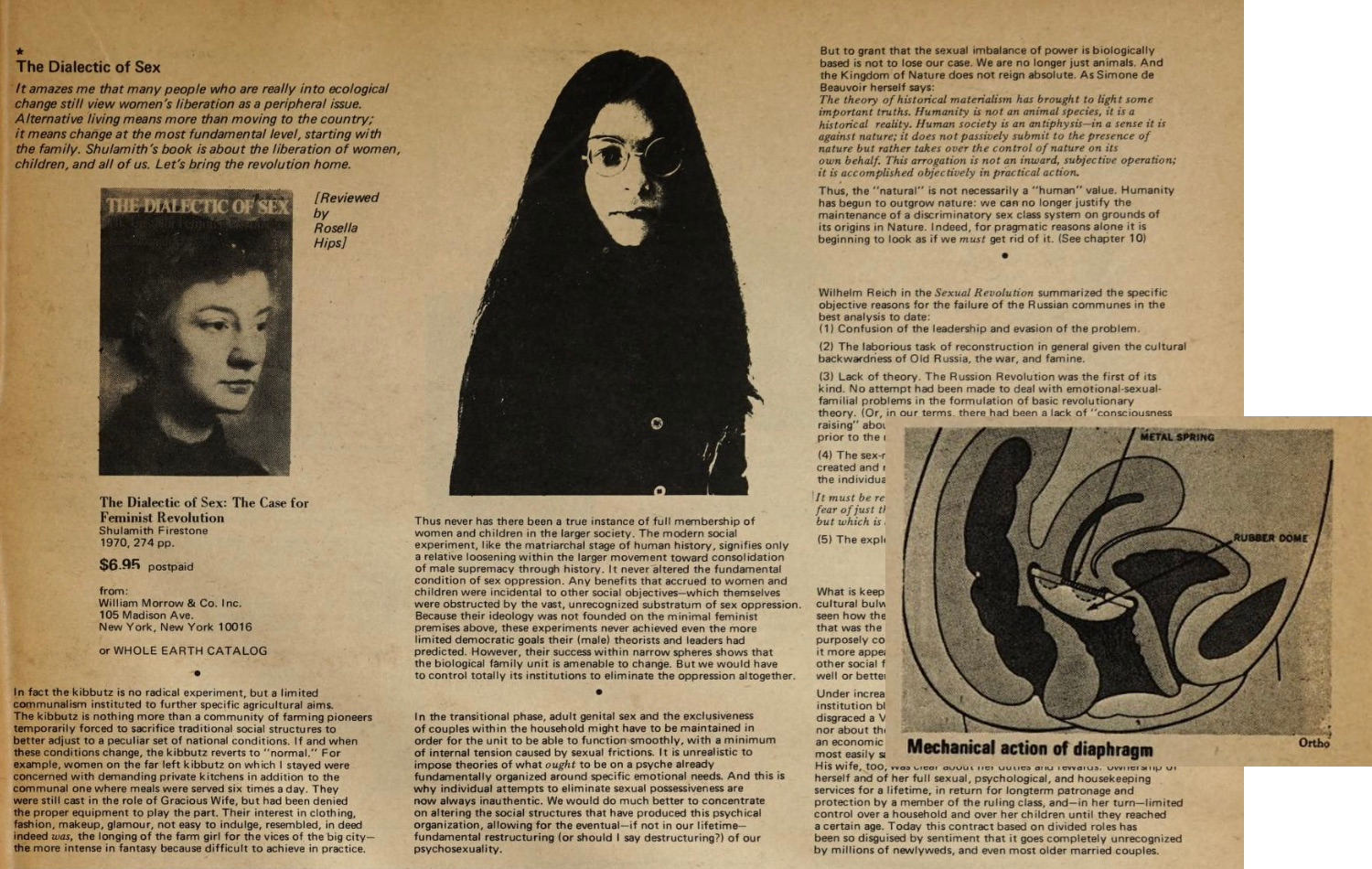
In the Catalog’s early days, so-called “women’s issues” were a tertiary concern, but were always given a small amount of space. The Fall 1970 edition featured a section on birth control, including a recommendation from Brand himself, for the McGill Students’ Society Birth Control Handbook—he calls it “a book by the future for the future.” Nearby text (uncredited but possibly written by Brand) expands on that claim: “A woman now has the option of bearing and socializing children—it is no longer the sole source of her sexual and social identity.” Printed to the immediate left is a review for a Snugli baby carrier, underscoring how the Catalog aimed to reflect a spectrum of choices when it came to reproduction and parenting.
If birth control was a step towards a feminist future in which women’s bodies and lives were no longer reduced to their reproductive abilities, Shulamith Firestone’s The Dialectic of Sex was a dramatic leap. Firestone claims that biological “inequality” between men and women is the most profound source of social division, and “to survive in our time, we must dismantle the family and break down politically traditional sex-roles.” In her review of Firestone’s book (also in the Fall 1970 issue of the Catalog), contributor Rosella Hips writes, “It amazes me that many people who are really into ecological change still view women’s liberation as a peripheral issue.” She argues that “alternative living means more than moving to the country; it means change at the most fundamental level, starting with the family”—surely calling out some of the Whole Earth Catalog’s readers. In The Dialectic of Sex, Firestone makes the case that “what is natural is not necessarily human,” offering a futurist vision of fully automated reproduction via artificial wombs, which takes place in what Erin Maglaque describes as a “cybernetic communist utopia.”5
Refusing the reproductive role assigned to women was also a formative political commitment for CoEvolution Quarterly editor Stephanie Mills, a bioregionalist who helped strengthen CQ’s coverage of feminist theory and culture during her time at the journal. Mills had once issued a highly-publicized manifesto herself. Her commencement speech at Mills College, titled “The Future Is a Cruel Hoax,” was widely covered by the media in 1969, an act she later described as “the eco-feminist version of burning a draft card.” In the speech, Mills shares her intention not to have children, declaring: “Our days as a race on this planet are, at this moment, numbered, and the reason for our finite, unrosy future is that we are breeding ourselves out of existence. I am terribly saddened by the fact that the most humane thing for me to do is to have no children at all. But the piper is finally demanding payment.” She was influenced by the discourse around overpopulation, at this time heightened by the recent publication of The Population Bomb, a controversial book by Paul and Anne Ehrlich (Stewart Brand was also influenced by Paul Ehrlich, as he studied biology under him at Stanford). Mills is now in her late seventies, and has stuck with her decision. In her memoir, she writes that opting out of motherhood thrust her into “a curious antihero role,” and “though civilization affords little support, even less spiritual imagery, and no role models for women who choose not to be mothers, there does seem to be an ecological demand for them.”
Pat Califia’s “Feminism and Sadomasochism”6
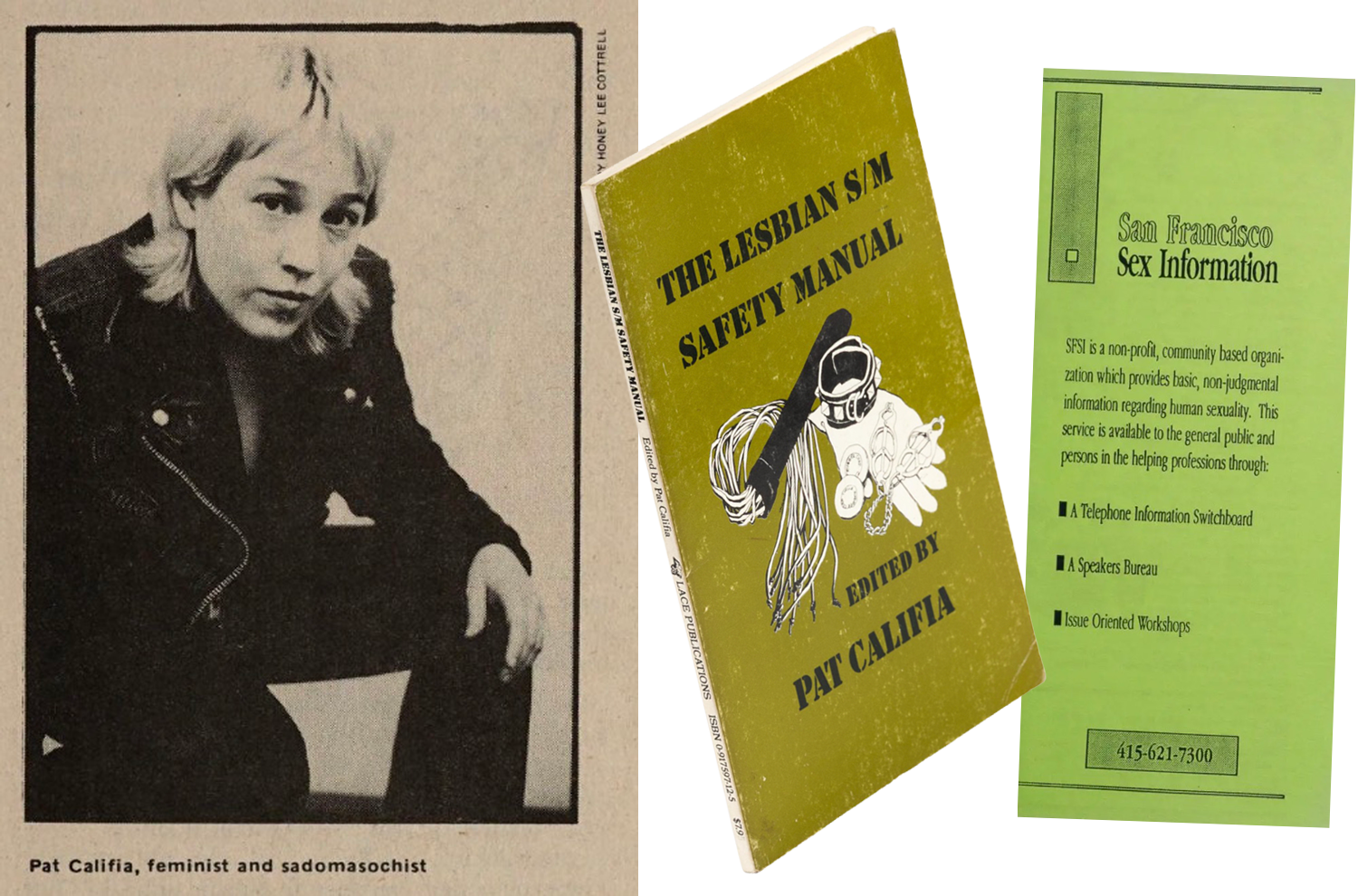
A writer of erotica and essays on sexuality, Pat Califia’s essay “Feminism and Sadomasochism” appears in a section on gender, also featuring essays on “vernacular gender” and pornography, in the Spring 1982 issue of CoEvolution Quarterly. After researching Califia’s work, it struck me that he was, not unlike Stewart Brand, something of a vanguard in the world of information access and self-education in the Bay Area of the 70s—though a very different kind (Note: Califia used “she/her” pronouns when the article was published but now uses “he/him”). Califia worked as a sex educator at the San Francisco Sex Information switchboard and eventually published a popular sex guide called Sapphistry: The Book of Lesbian Sexuality, among a number of other books and articles that variously fall into the categories of sex writing, autotheory, and erotica. He gained notoriety for writing openly about his participation in the S&M scene at a time when the lesbian community was extremely wary of, if not outright opposed to, these practices, viewing them as degrading towards women, the product of a twisted gay male sexual culture that would be unimaginable to identify with. Swimming against this current posed an enormous amount of anxiety and risk for Califia, something he writes about in the introduction to his 1994 book Public Sex: The Culture of Radical Sex:
I got a call at two o’clock in the morning from Barbara Grier of Naiad Press, threatening to cancel the publication of my first book, Sapphistry, a lesbian sex-education manual. It was hard to tell which upset her more: the fact that I had publicly revealed my identity as a leather person (“You might as well tell people you are a murderer!”) or my statement that S/M was so important to me I would rather be marooned on desert island with a male masochist than a vanilla dyke (“We do not publish books by bisexual women!”).
In the end, though, Sapphistry was not only published, but (according to Califia) remained a top seller at Naiad Press for more than a decade. “Real dykes, both feminist and nonfeminist, didn’t care what their self-appointed leaders thought,” Califia argues. “They bought Sapphistry. If their local women’s bookstores wouldn’t carry it, they mail-ordered it.”
“Feminism and Sadomasochism” was first printed in Heresies, an influential feminist journal, and republished in the CoEvolution Quarterly by Mills. In it, Califia debunks many common misconceptions about S/M play and challenges readers to recognize that a culture of “sexual deviancy,” in the context of the repressive, patriarchal society they live in, is in fact a good thing. Relationships made through kink are formed around consent and the co-creation of a dynamic with a partner, representing “the quintessence of nonreproductive sex,” he argues. Califia’s essay is far from purely informative, though—it also functions as a manifesto on the revolutionary power of queer perversion, rallying against all manner of essentialist thinking about sex, gender, and society. Some of his sharpest criticisms are actually directed toward the feminist movement, though he still identifies as a feminist. “A movement that started out saying biology is not destiny is trashing transsexuals and celebrating women’s ‘natural’ connection to the earth and living things,” he laments, declaring that he won’t blindly support women just because they’re women; feminist women should try to learn more from “politicized or deviant” men. “I believe that men can be committed to the destruction of the patriarchy,” he argues; “after all, the rewards of male dominance are given only to men who perpetuate and cooperate with the system … I do not believe that women have more insight, intuition, virtue, identification with the earth, or love in their genes than men.” In Califia’s telling, deconstructing a rigidly normative and binary understanding of gender is a vital tool for the dismantlement of patriarchy, and replaces an essentialist narrative about a “battle of the sexes” in which women alone are victimized.
“Feminism and Sadomasochism” suggests that “woman,” as a binary category and a politicized identity, was a problematic object to organize around, and perhaps new models for solidarity and struggle were in order. This was a theory that Simone de Beauvoir gestured at way back in 1949 in her groundbreaking philosophical treatise The Second Sex; she concludes the book by arguing for the establishment of a new kind of “brotherhood” between women and men. Four decades later, Judith Butler would expand upon de Beauvoir’s ideas in writings that would lay the groundwork for an emerging field of gender and sexuality studies. In “Performative Acts and Gender Constitution” (1988), Butler cites the philosopher Julia Kristeva’s theory that “strictly speaking, women cannot be said to exist” while building the argument that gender can be understood as a type of performance.
Donna Haraway’s Simians, Cyborgs and Women7
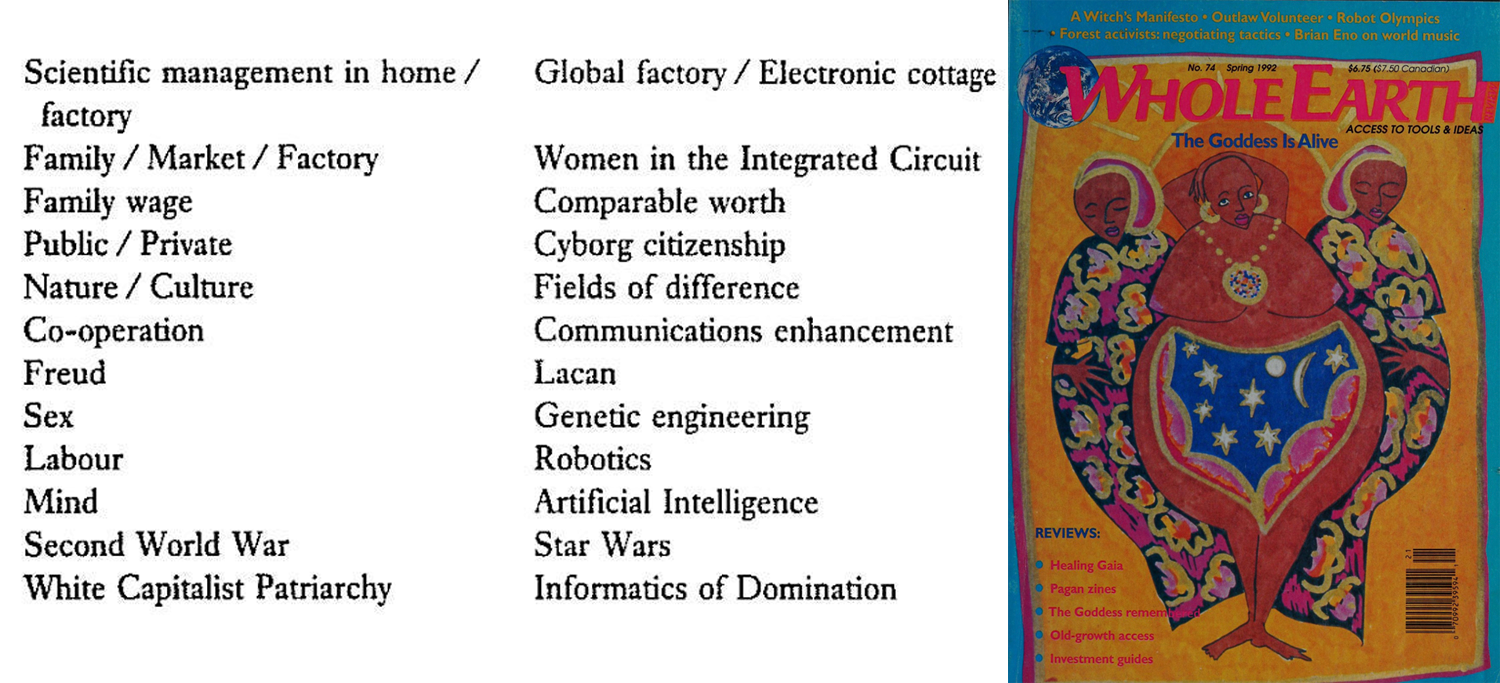
This raises the question: if women don’t exist, what are we left with? A compelling answer comes from a scholar working across the traditional border between the sciences and the humanities: Donna Haraway. Haraway’s “Manifesto for Cyborgs: Science, Technology, and Socialist-Feminism in the 1980s” was published in Socialist Review in 1985, and later updated for Haraway’s book Simians, Cyborgs and Women; in it, she attempts to construct an alternative to the one-with-the-earth “goddess” archetype frequently invoked by eco-feminists in the ‘70s. In its place, Haraway offers the cyborg, a being that is not wholly endemic to either nature or technology, but rather a self-constructing hybridization of both; she proposes that “a cyborg world might be about lived social and bodily realities in which people are not afraid of their joint kinship with animals and machines, not afraid of permanently partial identities and contradictory standpoints.” Ironically, though, the 1992 issue of the Whole Earth Review that promoted Haraway’s book had a cover feature called “The Goddess Remembered.”
Donna Haraway attributes certain qualities to the cyborg that perfectly encapsulate the feminist vanguard of the 1980s. An important function for the cyborg is writing: she argues that “Writing is preeminently the technology of cyborgs,” and “Cyborg politics is the struggle for language and the struggle against perfect communication.” As a mythic image, the cyborg offers “a way out of the maze of dualisms in which we have explained our bodies and our tools to ourselves,” says Haraway. “This is a dream not of a common language, but of a powerful infidel heteroglossia.” For me, the cyborg offers an ideal feminist archetype for the information age, a hybrid, fluid, often illegible entity that rewrites its own future. The cyborg is inherently a contradiction; its survival depends on both its collaboration with new technologies and its resistance to their potential to harm and dominate.
Remembering the feminist counterpublics that flourished during the zenith of small press publishing feels critical in a moment where toxic masculinity has hijacked online infocultures. The Whole Earth Catalog has a complex connection to this strange and backwards evolution. Reading Stewart Brand’s statement on the Catalog’s purpose (“We are as gods, and we might as well get good at it”), one sees how his thinking inspired the do-it-yourself movement, out of which came the first wave of Silicon Valley hackers. Steve Jobs once referred to the Whole Earth Catalog as “one of the bibles of my generation”; the two men shared a similar passion for the god-like creative potential they saw emerging through advances in technology. Today, some version of that ideology clearly lives on in the minds of Silicon Valley technocrat types, who see their role in shaping emergent technologies like AI in quasi-religious terms, evoking a kind of manifest destiny for the 21st century.
Could survival simply be a matter of acquiring the right “tools”? Donna Haraway engages with the tool in her manifesto, noting that “myth and tool mutually constitute each other.” As part of this symbiotic relationship, one must also consider how “sex, sexuality, and reproduction are central actors in high-tech myth systems structuring our imaginations of personal and social possibility.” Pat Califia explores the same idea from a more personal vantage point. In a piece on genderbending, he jokes, “I love technology,” recounting the experience of putting on a (homemade) strap-on dildo that fit perfectly thanks to its Velcro straps. “Pornography is made for men, not women—except in my bed, where I will try to give another woman every pleasure, power, and privilege that men want to keep for themselves,” Califia writes, but only after spending several steamy paragraphs actually narrating the sex he has with the strap-on; evidence of his side-gig as a prolific writer of erotica. Queer sexuality has a toolbox (or toybox) that provides access to new kinds of bodily pleasures, but more importantly, it facilitates social reproduction outside of a heteropatriarchal mold—forming new kinds of intimate relationships, families, communities. New worlds. Instead of the tired old gods and goddesses, the subjects of this new social reality closely resemble Haraway’s self-mutating cyborg: not nature, not dominant over nature, but part of a different story altogether.
Whether the Whole Earth Catalog itself should be counted as a feminist tool for survival is a difficult question to answer; for as much as it included radical feminist ideas, it also omitted and contradicted them. One thing is certain, though: as a publishing platform that grew increasingly diverse and participatory over the years, Whole Earth established a space in which social and technological progress were discussed side-by-side, forming part of the same future-forward infoculture. In News that Stayed News, an anthology of CoEvolution Quarterly articles from 1974 to 1984, editor Art Kleiner notes that many readers wrote in to protest Pat Califia’s “Feminism and Sadomasochism” (less than a year earlier, a similar protest had ensued when CQ published an illustration of lesbian space sex by Betty Dodson). But then “other readers responded to those letters,” says Kleiner, who argues that Califia’s piece was “one of the best articles CoEvolution has ever published,” presumably because it became such a rich source of debate.
It seems the audience that had originally formed around the Whole Earth Catalog wasn’t entirely accepting of queer deviancy, but the human care that went into cultivating and moderating the platform could accommodate this ideological friction, allowing for a feminist counterpublic to take shape amid a wider conversation. On today’s massive, algorithm-driven internet, that kind of friction rarely produces opportunities for learning and critical thought, resulting, rather, in viral outrage and the collapse of productive discourse. What might happen if we reverted instead to an internet that resembled a collection of human-scale publishing projects, with clearly defined boundaries between “commerce” and “the commons?” It would at least be a healthier place for cyborgs to write to each other.
- Stewart Brand, “We Are As Gods,” Whole Earth Magazine, Winter 1998. [↩]
- Audre Lorde, “The Master’s Tools Will Never Dismantle the Master’s House,” in Sister Outsider: Essays and Speeches (Crossing Pres, 2007), 110-114. [↩]
- Michael Warner, Publics and Counterpublics (Zone, 2002), 56-7. [↩]
- Rosella Hips, “The Dialectic of Sex,” review of The Dialectic of Sex, by Shulamith Firestone, Whole Earth Catalog, Fall 1970. [↩]
- Erin Maglaque, “The radical legacy of Shulamith Firestone,” The New Statesman, October 21, 2020. [↩]
- Pat Califia, “Feminism and Sadomashochism,” CoEvolution Quarterly, Spring 1982. [↩]
- Richard Kadrey, “Simians, Cyborgs, and Women,” review of Simians, Cyborgs, and Women, by Donna Haraway, Whole Earth Review, Spring 1992. [↩]
Ana Tuazon is a writer and educator based in Oakland, California. Her writing on art, culture and social movements has been featured in a number of outlets including Frieze and n+1's Track Changes: A Handbook for Art Criticism.